Streamlining Safety-Critical Rail Software Development: Leveraging Ansys SCADE for KAVACH Control Logic and DMI
As Indian Railways accelerates the nationwide deployment of KAVACH, its indigenous Automatic Train Protection (ATP) system, ensuring the reliability and safety of the underlying software has become a critical priority.
SK
Sujith Kudupudi
Jun 12, 20268 min read
As Indian Railways accelerates the nationwide deployment of KAVACH, its indigenous Automatic Train Protection (ATP) system, ensuring the reliability and safety of the underlying software has become a critical priority. Designed to prevent collisions and overspeeding through continuous monitoring and automatic intervention, KAVACH is set to play a pivotal role in enhancing railway safety across India's expanding rail network. As deployment scales, so does the need for software that meets the highest levels of safety, reliability, and regulatory compliance.
Developing such safety-critical systems is no simple task. Compliance with EN 50128 SIL-4, the highest safety integrity level for railway software, demands rigorous verification, validation, traceability, and documentation throughout the development lifecycle. Traditional approaches based on manual coding and extensive late-stage testing often struggle to meet these requirements efficiently. By adopting a Model-Based Design (MBD) approach with Ansys SCADE, engineering teams can streamline development, strengthen traceability, automate verification activities, and accelerate the path to certification with greater confidence.
Regulatory and Operational Challenges in SIL-4 Systems
EN 50128 governs software development for railway control and protection systems, with SIL-4 representing the highest level of safety integrity. It mandates:
Formalized software design and structured methodologies
Exhaustive verification and validation processes
Complete traceability from requirements to implementation
Separation between development and verification roles
In traditional workflows, these requirements translate into significant challenges:
High manual coding effort, increasing the risk of human errors
Traceability management, often requiring extensive documentation
Late-stage defect discovery, leading to costly rework and delays
Verification occurs only at the code level, not possible to verify during the design stage.
These challenges are especially critical in KAVACH, where reliability directly impacts operational safety.
Transitioning to Model-Based Design with Ansys SCADE
Ansys SCADE (Safety-Critical Application Development Environment) addresses these challenges through a model-based development tailored for safety-critical systems.
Instead of writing code first and verifying later, SCADE shifts development to formal, executable models, ensuring correctness early in the lifecycle.
Key capabilities include:
Deterministic Modeling: Systems are defined using data-flow diagrams and hierarchical state machines, ensuring predictable and unambiguous behaviour
Qualified Code Generation (KCG): Automatically generates ANSI C code that is mathematically equivalent to the validated model
Integrated Verification: Supports simulation, testing, and formal verification directly at the model level
End-to-End Traceability: Links requirements, models, and tests seamlessly
By moving verification early to the design level, SCADE allows engineers to focus on system behaviour rather than low-level code implementation.
Practical Implementation: KAVACH Subsystems in SCADE
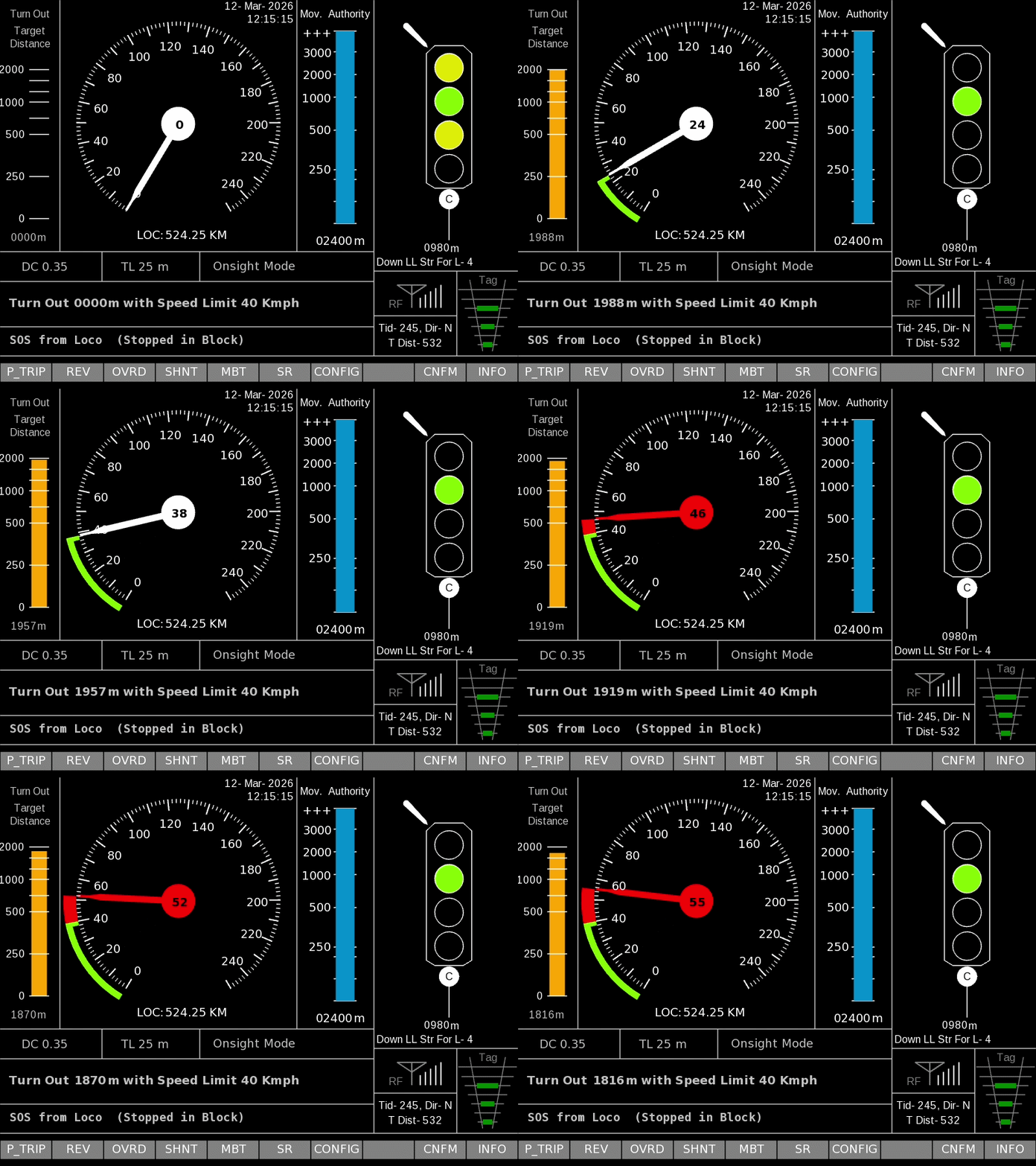
DMI Development with SCADE Display
SCADE Display enables efficient development of the KAVACH Driver Machine Interface (DMI) - LP-OCIP panel.
Fig.1 KAVACH LP OCIP / DMI developed in Ansys SCADE Display
Design changes are applied directly at the model level and automatically reflected in generated code, ensuring consistency and eliminating manual rework.
The tool supports safety-critical graphics standards such as OpenGL SC/ES, enabling deployment in certified embedded environments.
Control Logic and Mode Management with SCADE Suite
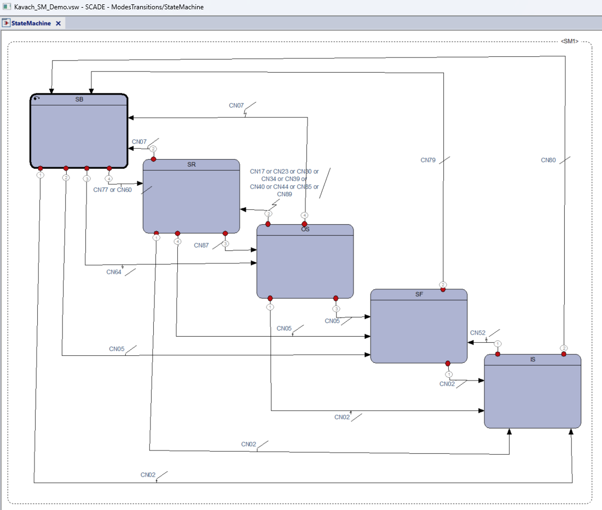
KAVACH control functions such as braking logic, speed supervision, and mode transitions which can be modeled using hierarchical state machines in SCADE Suite.
Fig.2 KAVACH Mode Transitions
This approach provides:
Clear visualization of system behaviour
Early validation through simulation
Automatic generation of production-ready application code
Engineers can validate complex scenarios such as transitions between operational modes before implementation, significantly reducing risk during integration and testing.
Navigating EN 50128 Compliance with SCADE
Achieving EN 50128 compliance traditionally involves significant manual effort. SCADE simplifies this by embedding required techniques and measures directly into the development process.
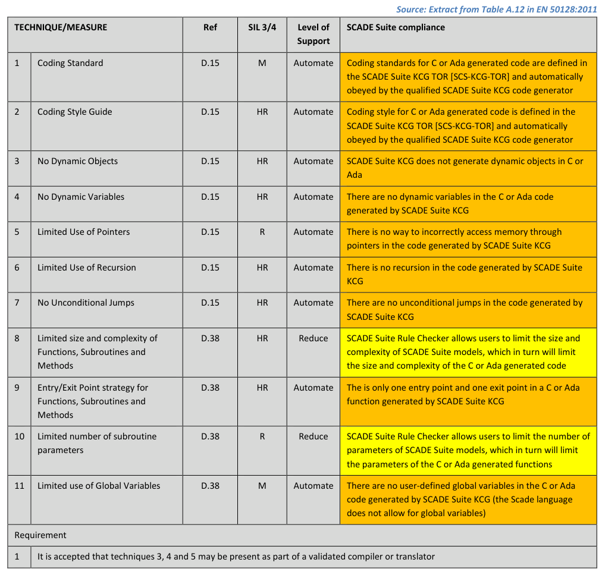
The SCADE methodology handbook provides detailed compliance matrices that map EN 50128 techniques and measures to SCADE capabilities. These tables help engineers understand how specific requirements, especially for SIL-3/4 systems, are supported by the SCADE toolchain.
Fig.3 EN 50128 coding compliance table excerpt
The compliance matrix illustrated above is extracted from the SCADE Methodology Handbook, which provides detailed mapping of EN 50128 techniques and measures to the SCADE toolchain.
The toolchain supports the full software lifecycle which are requirements, design, implementation, and testing:
Certified auto code generation and enforceable coding standards
Verification activities such as functional testing and coverage analysis
Automatic design and test report generation
Importantly, the qualified code generator produces traceable, standards-compliant code, reducing the need for manual coding and associated verification activities at the code level.
This ensures that compliance is achieved as part of the workflow rather than through additional documentation effort, enabling faster and more reliable certification.
Verification: Testing, Model Coverage, and Formal Methods
Verification is central to EN 50128, and SCADE provides a comprehensive framework aligned with its requirements.
Model-Based Testing
Using SCADE Test, engineers can perform Model-in-the-Loop (MiL) testing for early validation. This allows validation of KAVACH control logic and DMI behaviour early in development, reducing downstream defects.
Model Coverage Analysis
SCADE supports coverage criteria such as MC/DC, ensuring completeness of test cases.
A key advantage is that model-level coverage directly maps to code-level coverage for generated code, simplifying compliance for higher SIL levels.
Formal Verification
With SCADE Design Verifier, safety properties can be mathematically proven.
This enables:
Detection of corner-case failures
Validation of safety-critical conditions
Increased confidence in system correctness
Why SCADE is right fit for KAVACH Development
For KAVACH developers, SCADE offers several key advantages:
Reusable components, accelerating development across subsystems
Early error detection, minimizing rework
Reduced certification risk, especially for SIL-3/4 applications
By shifting effort from manual coding to model validation, SCADE enables teams to deliver safer and more reliable railway systems.
Conclusion
As KAVACH deployment scales across the Indian railway network, adopting modern development methodologies becomes essential. Ansys SCADE provides a robust, model-based framework that aligns naturally with EN 50128 requirements, transforming compliance from a complex manual process into an integrated, tool-driven workflow.
For engineering teams working on safety-critical railway systems, this approach not only accelerates development but also strengthens confidence in achieving the highest levels of functional safety.