Connect

Establish a Digital Thread for simulation

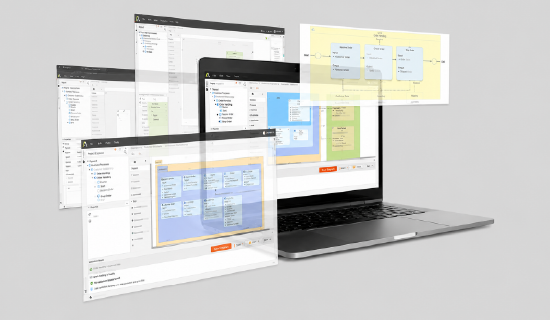
Connect simulation overview

Bridge today's simulations to mold tomorrow's transformations.

Ansys Connect stands as the sole open ecosystem-driven solution, leveraging top-tier software for various capabilities such as materials, optimization, MBSE, and SPDM. This platform facilitates widespread simulation integration across a broader spectrum of the product development.

Applications

Electric Motors

Perform a multiphysics design optimization of an electric motor.

Battery Simulation

Optimize battery performance, while minimizing costs and testing duration through the utilization of simulation digital thread.

Brake Systems

Perform robustness evaluations of brake squeal noise. Design optimization and robustness of a passenger car brake rotor. Identify cost-effective design configurations that meet performance requirements, considering factors such as material selection, manufacturing processes, and component geometry.

Autonomous Driving

Perform scenario based risk analysis: Quickly compute failure probability in autonomous driving.

Optical Systems

Automation of STOP (Structural-Thermal-Optical-Performance) Analysis. Robust Design Optimization of optical systems.

Electric Motors

Perform Multiphysics optimisation of Electric Machines using Motor-CAD and optiSLang.

Ships

Perform optimization and robustness analysis of Ship design. Optimize the cruise liner weight under stress restrictions.

Optical Systems

Create an automated workflow for STOP (Structural-Thermal-Optical-Performance) Analysis and leverage cutting edge AI-based optimization algorithms to obtain the optimized optical systems. Robust Design Optimization of optical systems.

Electric Motors

Perform a multidisciplinary Optimization of an Electric Motor and connect the analysis to SysML Model for the requirements verification.

Phased Array Antenna

Applying Model-Based Systems Engineering (MBSE) and Multidisciplinary Analysis and Optimization (MDAO) to the development of Phased Array Antenna Models to Improve Design Time and Quality.

Gas Turbines

In gas turbine applications, ANSYS Minerva can streamline the design process by integrating simulation data to optimize turbine performance, efficiency, and durability. It facilitates collaboration among engineers, enabling them to leverage simulation insights to make informed decisions and iterate on design improvements.

Medical Devices

In the medical devices industry, ANSYS Minerva facilitates efficient collaboration and decision-making by integrating simulation data. It supports the design and optimization of medical devices such as implants and prosthetics, enabling engineers to ensure product safety, efficacy, and regulatory compliance while accelerating time-to-market.

Avionics and Flight Controls

ANSYS Minerva streamlines avionics and flight control development by integrating simulation data. It optimizes system designs, validates algorithms, and enhances performance while ensuring compliance and reducing development time.

Industrial Machinery

ANSYS Minerva assists in optimizing industrial machinery by integrating simulation data to improve design efficiency, performance, and reliability. It streamlines collaboration, accelerates decision-making, and enhances the development process, ultimately leading to more robust and cost-effective machinery solutions.

FAQs

What is a digital twin?

A digital twin is a virtual replica of a physical asset, system, or process that is continuously updated with real-world operational data. It combines physics-based simulation with live sensor inputs to mirror the current state of its physical counterpart and support predictive decision-making.

What is Ansys Twin Builder?

Ansys Twin Builder is a multi-domain system simulation platform that enables engineers to create, validate, and deploy physics-based digital twins. It combines ROM technology, machine learning, and real-time IoT data integration to build operational twins that run in industrial deployment environments without requiring Ansys licences on the target hardware.

How do digital twins support predictive maintenance?

Digital twins continuously compare live sensor data against physics-model predictions to detect deviations that indicate degradation or developing faults. By tracking accumulated damage and remaining useful life in real time, they enable maintenance to be scheduled based on actual asset condition rather than fixed intervals — reducing both unplanned downtime and unnecessary servicing.

What is a reduced-order model (ROM)?

A reduced-order model compresses a high-fidelity simulation — such as an FEA or CFD model — into a compact mathematical representation that reproduces the same physics at a fraction of the computational cost. ROMs are essential for digital twin deployment because they allow rigorous physics to run in real time on edge or cloud hardware.

How does Ansys Twin Builder integrate with IoT platforms?

Ansys Twin Builder exports digital twins as portable runtime packages with standard REST API interfaces. These runtimes can be connected to industrial IoT platforms — such as AWS IoT, Azure Digital Twins, or PTC ThingWorx — to receive live sensor data streams and return updated state estimates, predictions, and recommendations through the same interface.

What industries benefit most from digital twins?

Digital twins deliver the greatest value in industries with complex, high-value, or safety-critical assets — including energy and utilities, aerospace and defence, automotive and EV, industrial machinery, and semiconductor manufacturing. Any sector where unplanned downtime is costly or where continuous performance optimisation drives competitive advantage can benefit from digital twin technology.

Let’s Build What’s Next Together

Whether you're solving complex engineering challenges, accelerating innovation, or exploring new possibilities with simulation and digital engineering, our team is ready to support you. Backed by deep technical expertise and industry experience, we work closely with organizations to transform ideas into reliable, high-performance solutions. Connect with us to discover how CADFEM can help drive your next breakthrough.

CONTACT US

Contact Us Today