Modern radar simulation requires accurate flight path design, realistic scenario modeling, and detailed electromagnetic representation of radar systems. Systems Tool Kit (STK) provides a comprehensive environment for designing and analyzing platform and target trajectories within dynamic scenarios, while Perceive EM enables detailed radar modeling and electromagnetic sensing analysis.
Integrating these capabilities establishes a seamless simulation workflow in which flight path profile from STK is incorporated into Perceive EM for realistic radar scenario evaluation. This integrated approach enables Range-Doppler (RD) map generation, target detection analysis, motion characterization, and assessment of radar performance under dynamic operational conditions.
Section 01The Role of Range-Doppler Maps in Radar Simulation
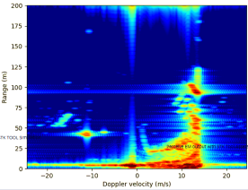
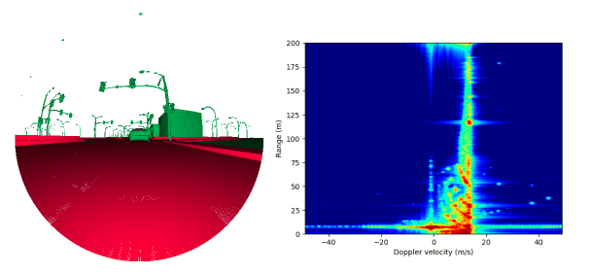
Range-Doppler (RD) maps play a key role in radar simulation by transforming simulated radar returns into an intuitive representation of target range and relative velocity. Instead of analyzing raw received signals directly, the RD map provides a clear view of where targets appear in the radar scene and how their motion influences the received signal.
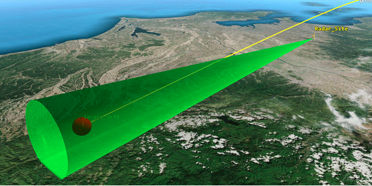
STK considers the time-varying attitude of the platform to accurately represent its orientation and radar pointing direction, enabling realistic determination of radar–target geometry and supporting subsequent electromagnetic analysis in Perceive EM.
The RD map helps to:
- Determine target range from the propagation delay of the received signal.
- Identify multiple targets based on their different range and velocity characteristics.
- Visualize target responses as peaks or high-energy regions within the RD domain.
- Analyze target motion as changes in trajectory cause corresponding shifts in range and Doppler.
- Evaluate radar performance by examining detection capability, range resolution, Doppler resolution, and signal response.
Section 02The Role of Systems Tool Kit (STK)
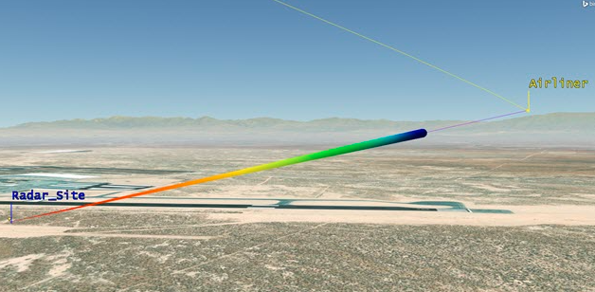
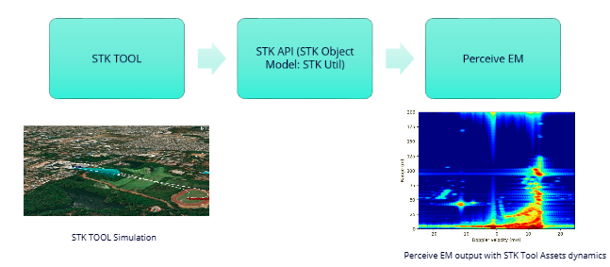
Systems Tool Kit (STK) establishes the kinematic and geometric foundation of the radar simulation by modeling aircraft and target motion within a dynamic 3D environment. It provides time-dependent position, velocity, attitude, and radar–target geometry, including range, azimuth, elevation, and relative velocity. This synchronized scenario data is transferred to Perceive EM, where it is used for electromagnetic radar modeling and target-response analysis, ultimately supporting Range-Doppler (RD) map generation, target detection, and radar performance evaluation under realistic dynamic conditions.
Key capabilities:
- 3D Visualization: Visualize the complete 3D scenario and monitor the time-varying motion and interactions of all objects.
- Dynamic Analysis: Analyze changing range, position, and relative motion.
- Scenario Modeling: Create realistic multi-platform and multi-target scenarios.
- Data Generation: Extract trajectory information for radar simulation.
- Integration: Connect STK with external tools through APIs and scripting.
Section 03The Role of Perceive EM in RD Map Generation Using SBR
Perceive EM provides the electromagnetic simulation layer for RD map generation after the scenario and trajectories are defined in STK. Using Shooting and Bouncing Rays (SBR) technology, it models radar-wave propagation, target scattering, and electromagnetic interactions. Radar parameters and dynamic target geometry are incorporated to generate realistic radar returns. The resulting coherent response data is then processed in the range and Doppler domains, producing the RD map for target detection, range estimation, velocity analysis, and radar performance evaluation.
Key capabilities:
- Advanced SBR Electromagnetic Simulation: Models propagation, reflection, diffraction, multipath, and scattering.
- Scalable API & GPU Computing: Enables automated Python/C++ workflows, headless simulation, and GPU-accelerated large-scale analysis.
- Radar Analysis: Supports radar modeling, scattering analysis, and SAR/ISAR imaging.
- Antenna & Material Modeling: Incorporates HFSS antenna patterns, advanced material properties, and surface roughness for accurate EM analysis.
- Wireless & AI/ML Applications: Supports 5G/6G channel modeling, indoor/outdoor propagation analysis, and synthetic data generation for AI/ML applications.
Section 04API-Based STK–Perceive EM Integration for Dynamic Radar Simulation
The STK–Perceive EM integration connects two essential views of a radar scenario: how the objects move and how the radar responds to that motion. STK acts as the kinematic engine, providing time-varying platform and target position, altitude, velocity, attitude, and radar–target geometry. As the target moves, parameters such as range, aspect angle, line-of-sight, and relative velocity continuously change.
This information is transferred through an API-based interface to Perceive EM, where the radar and target are represented using their electromagnetic characteristics, including frequency, bandwidth, waveform, antenna pattern, polarization, transmit power, receiver parameters, geometry, and material properties. Perceive EM then applies the Shooting and Bouncing Ray (SBR) method to model propagation, reflection, diffraction, multipath, and target scattering. The resulting time-varying radar echoes capture the electromagnetic response of the moving target and provide the basis for Range-Doppler map generation, target detection, and radar performance analysis.
Section 05From Kinematic Data to Radar Insight
- Realistic Mission Dynamics: Integrates time-dependent STK kinematic data with dynamic radar simulation for realistic target and radar analysis.
- SBR-Based EM Modeling: Simulates electromagnetic propagation, reflection, and target scattering.
- Coherent Radar Data: Generates response data across time, frequency, and spatial dimensions.
- Target Characterization: Enables analysis of range, radial velocity, and radar signatures.
- Efficient Workflow: Connects trajectory design, EM simulation, and radar analysis in one integrated process.
Section 06Real-World Applications of STK–Perceive EM Integration
The integration of STK and Perceive EM is valuable wherever dynamic target motion and electromagnetic radar behavior need to be analyzed together. By connecting trajectory data with SBR-based radar simulation, engineers can move from mission-level scenarios to realistic radar observables.
- Radar System Design: Evaluate radar performance against dynamic targets and varying geometries.
- Aerospace & Defense: Analyze airborne radar interactions with maneuvering aircraft and ground targets.
- Automotive Radar: Simulate vehicle motion, target detection, and changing radar perspectives.
- Radar Performance Assessment: Evaluate detection capability, resolution, target observability, and scattering responses for different target orientations and aspect angles.
- Synthetic Data Generation: Produce simulation data for testing, validation, and AI/ML-based radar applications.
ConclusionConclusion
The STK–Perceive EM integration provides an end-to-end workflow that combines dynamic kinematic modeling with high-fidelity electromagnetic radar simulation. STK defines the time-varying platform and target states, attitude, and radar–target geometry, while Perceive EM uses SBR-based modeling to simulate propagation, scattering, and realistic radar returns. These responses are processed into Range-Doppler maps, enabling analysis of target range, radial velocity, detection, and scattering characteristics.
By connecting scenario modeling → kinematics → EM interaction → radar response → RD map, the workflow improves simulation realism and bridges the gap between system-level and electromagnetic analysis. This foundation can support AI/ML-based sensing, synthetic data generation, autonomous detection, digital twins, advanced radar imaging, and real-time simulation, contributing to the development and validation of next-generation intelligent radar systems.
Found this useful? Share it