ANALYSIS TYPE / 07
Co-Simulation Between Fluids and Solids Due to Structural and Thermal Load Exchange
Overview
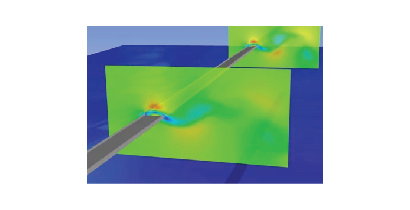
Fluid-Structure Interaction (FSI) is a multidisciplinary field that deals with the interaction between fluid flow and deformable structures to exchange loads. In computational fluid dynamics (CFD), FSI simulations involve modeling the coupled behavior of fluids and structures to analyze how fluid forces affect the deformation and response of solid objects. It is important in applications such as aircraft wings, wind turbines, and biomedical devices where understanding how fluid forces affect structural behavior is essential for design optimization and performance prediction.
Industries Served
Deliverables
Other CFD Services
Multi Phase & Multi SpeciesThermal ManagementExternal & Internal AerodynamicsSubsonic / Transonic / Supersonic FlowsAero-Vibro AcousticsBattery Management SystemsFluid-Structure InteractionHydraulic & TurbomachineryCombustion & Reaction ChemistryPolymer & Metal ProcessingCustomized Functional DevelopmentKey Aspects
Transferring fluid pressure loads to structural FEA to predict static deformation and stress — suitable when structural deformation has negligible effect on the fluid domain.
Iteratively coupling CFD and FEA solvers so structural deformation updates the fluid mesh and vice versa — capturing the full mutual interaction between fluid and structure.
Predicting vortex-induced vibration (VIV) and flutter of structures such as bridges, risers, and aircraft panels from unsteady fluid excitation.
Simulating blood flow through deformable arterial walls, heart valves, and stents — capturing haemodynamic loading and predicting device performance and fatigue life.
Connect with our CFD engineering team to discuss the right approach for your application.