Advanced CAE Simulation — from photon to perception
Explore the world of optics and photonics with advanced computer-aided engineering (CAE) simulation. We harness the power of simulation technology to drive innovation and excellence in optical design — from automotive lighting and LiDAR to photonic crystals and medical tissue modelling.
What We Deliver
Our optics and photonics team spans the full range of optical simulation disciplines — from geometric optics for automotive lighting compliance to FDTD electromagnetic simulation of nanoscale photonic structures. We bring the right tool and methodology to every optical challenge.
Whether you need photometric verification of an automotive headlamp, system-level LIDAR performance prediction, or quantum efficiency optimisation of a CMOS image sensor, our engineers deliver simulation results that reduce development risk and accelerate design sign-off.
Key Problems We Solve
11 Analysis Types
Select an analysis type to explore the methodology, deliverables, and tools in detail.
ANALYSIS TYPE / 01
pixel-level response · QE · optical crosstalk
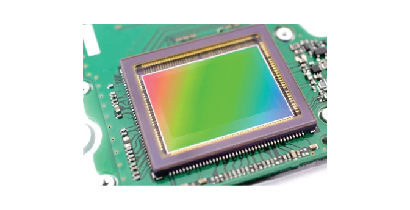
CMOS image sensor simulation models the optical response of pixel arrays, microlens efficiency, angular sensitivity, cross-talk, and quantum efficiency — enabling optimised sensor architecture for automotive, smartphone, and industrial imaging applications.
Key Aspects
Simulating the focusing efficiency of microlens arrays over each pixel — optimising lens shape, pitch, and material to maximise light collection and reduce optical crosstalk.
Computing spectral quantum efficiency by tracing photons through the optical stack into the photodiode — guiding passivation, AR coating, and deep trench isolation design.
Evaluating the sensitivity drop at high chief ray angles (CRA) across the full image field — matching the sensor CRA characteristic to the camera lens design.
Quantifying optical crosstalk between adjacent pixels and its impact on the modulation transfer function — guiding deep trench isolation geometry and colour filter design.
ANALYSIS TYPE / 02
negative index · perfect absorber · engineered EM response
Metamaterial simulation enables the design of artificially structured materials with customised electromagnetic and optical properties — including negative-index media, perfect absorbers, super-lenses, and cloaking structures.
Key Aspects
Designing the resonant element geometry (split-ring resonators, fishnet structures, patches) and extracting effective medium parameters (ε, μ, n) using Bloch-Floquet analysis.
Computing the S21, S11, and absorption spectra of the metamaterial slab — verifying that the designed resonance and absorption band are at the target frequency.
Engineering multi-layer or patterned structures to achieve near-unity absorption at a specific frequency — for selective thermal emitters, sensors, and stealth applications.
Evaluating how manufacturing variation in feature size, layer thickness, and material properties shifts the resonance frequency — informing lithography and deposition tolerances.
ANALYSIS TYPE / 03
headlamp · DRL · tail lamp · photometric compliance
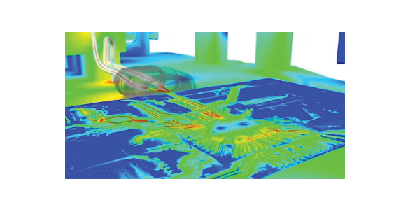
Automotive optical simulation covers headlamp beam pattern design, DRL/position light uniformity, interior ambient lighting, and photometric compliance with ECE and FMVSS regulations — from LED source to final light distribution on the road.
Key Aspects
Simulating the full headlamp optical system — LED source, primary optics, reflector, and projection lens — to design the low and high beam patterns to ECE R112 or FMVSS 108 requirements.
Optimising light guide geometry, LED pitch, and diffuser profiles to achieve luminance uniformity and intensity compliance for daytime running lights and position lamps.
Computing the test point values at all regulatory measurement points — verifying pass/fail against ECE and SAE standards before physical prototype measurement.
Evaluating LED junction temperature rise under operational conditions and its effect on luminous flux, colour shift, and optical performance — coupling photometric simulation with thermal CFD.
ANALYSIS TYPE / 04
point cloud simulation · detection performance · adverse weather
LiDAR simulation models the full system optical chain — emitter, beam steering, propagation, target interaction, and detector — enabling performance prediction for ranging accuracy, field of view, and detection probability in automotive ADAS systems.
Key Aspects
Simulating VCSEL or fibre laser emitter divergence, pulse shape, and steering mechanism — mechanically rotating, MEMS mirror, OPA, or flash — to predict the beam footprint at range.
Computing the optical return power as a function of target reflectivity, range, incidence angle, and surface roughness — predicting the signal margin at the minimum detectable range.
Simulating the effect of rain, fog, snow, and direct solar illumination on LiDAR detection range and false alarm rate — quantifying the performance degradation at different weather conditions.
Predicting angular resolution, range precision, and point density across the field of view — evaluating the minimum object size detectable at different ranges and velocities.
ANALYSIS TYPE / 05
horticultural · human-centric · adaptive street lighting
Smart lighting simulation covers adaptive street lighting, horticultural lighting, tunable white systems, and human-centric lighting design — modelling light distribution, spectral power, colour rendering, and energy efficiency.
Key Aspects
Optimising the spectral power distribution of multi-channel LED luminaires — balancing colour rendering index (CRI), colour temperature, and energy efficiency for the target application.
Computing PPFD (Photosynthetic Photon Flux Density) distribution over crop canopies — designing LED grow light fixtures to achieve uniform, target PPFD with minimum energy consumption.
Evaluating melanopic equivalent daylight illuminance (MEDI) and its circadian stimulus effect — designing tunable white lighting systems that support alertness and sleep cycles.
Computing illuminance uniformity and glare rating (UGR) for road and area lighting to EN 13201 standards — optimising luminaire type, mounting height, and spacing.
ANALYSIS TYPE / 06
combiner · waveguide · eye-box · image quality
HUD simulation models the combiner optics, waveguide, and projection system to ensure correct image placement, eye-box coverage, luminance uniformity, and distortion control in automotive and aviation head-up display systems.
Key Aspects
Computing the region in 3D space within which the virtual image is visible and undistorted — optimising combiner curvature and screen position to meet the eye-box size requirement for all occupant positions.
Evaluating the geometric distortion, colour aberration, and astigmatism of the projected virtual image — guiding corrective pre-distortion in the image generator and optic design.
Computing the virtual image luminance and contrast ratio against the real-world background at different solar loading and ambient conditions — verifying daytime and night-time readability.
Analysing the uniformity of the exit pupil expander (EPE) and fold grating in waveguide AR-HUD designs — minimising brightness roll-off and rainbow artefacts across the FOV.
ANALYSIS TYPE / 07
camera system · sensor fusion · perception validation
ADAS optical simulation models camera system performance — including resolution, MTF, dynamic range, and lens flare — alongside radar and sensor fusion, to validate detection and perception algorithms before hardware integration.
Key Aspects
Computing the system modulation transfer function from lens to sensor — predicting the spatial resolution available to perception algorithms at different scene distances and illumination levels.
Tracing ghost reflections and stray light paths through the camera optical system — identifying configurations that saturate the image or create false detection artefacts.
Evaluating camera response in high-contrast scenes — headlamps at night, tunnel entry, or direct solar glare — and verifying that the HDR imaging system maintains lane and object detection.
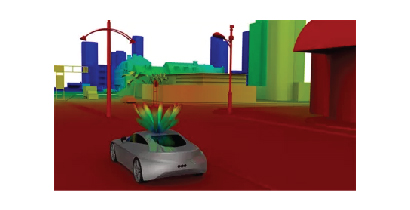
Generating synthetic sensor data (camera, LiDAR, radar) in a virtual driving environment to validate sensor fusion algorithms and perception pipelines before physical testing.
ANALYSIS TYPE / 08
physically based · appearance design · virtual prototyping
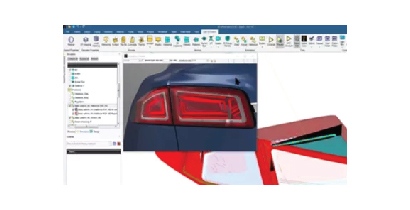
Physically based rendering (PBR) simulation produces photorealistic visualisations of products by accurately modelling light–material interactions including reflection, refraction, scattering, and subsurface transport — used for virtual prototyping and design review.
Key Aspects
Defining BSDF (Bidirectional Scattering Distribution Function) models for all surface materials — including anisotropic metals, painted plastics, textiles, and glass — to reproduce their real appearance.
Configuring HDR environment lighting, area lights, and sun/sky models to replicate the intended product usage environment — showroom, outdoor, studio, or driving scene.
Computing accurate global illumination including indirect bounce light, colour bleed, and caustic patterns through transparent parts — producing photorealistic scenes indistinguishable from photography.
Generating batches of rendered variants with different colours, materials, and trim options — enabling stakeholder sign-off on appearance before physical prototypes are available.
ANALYSIS TYPE / 09
aberration correction · tolerancing · manufacturability
Lens design simulation covers sequential and non-sequential ray tracing for cameras, microscopes, telescopes, projectors, and laser systems — optimising aberration correction, transmission, and manufacturability within tight tolerances.
Key Aspects
Evaluating all third-order and higher-order Seidel aberrations — spherical, coma, astigmatism, field curvature, distortion, and chromatic — and designing corrective element combinations.
Defining and optimising a merit function that balances wavefront error (RMS WFE), spot size, distortion, and chief ray angle across the full field and wavelength range.
Quantifying the sensitivity of optical performance to manufacturing tolerances — element tilt, decenter, thickness, surface irregularity — predicting yield and informing tight-tolerance elements.
Tracing parasitic reflections and ghost images through the lens system using non-sequential ray tracing — identifying critical surfaces for AR coating and baffling requirements.
ANALYSIS TYPE / 10
light propagation · absorption · scattering · dosimetry
Tissue modelling simulates light absorption, scattering, and fluorescence in biological materials — enabling the design of medical devices, PDT systems, OCT instruments, and surgical lasers with accurate dosimetry predictions.
Key Aspects
Simulating the statistical path of photons through turbid biological tissue using Monte Carlo methods — computing fluence rate distribution and absorbed energy density.
Specifying tissue optical properties — absorption coefficient, scattering coefficient, anisotropy factor, and refractive index — as a function of wavelength from published literature or measurement data.
Computing the photodynamic therapy light dose distribution in tissue — predicting the treatment volume and ablation boundary for a given source geometry and irradiance level.
Simulating the optical coherence tomography signal from layered biological tissue — predicting penetration depth, signal-to-noise ratio, and sensitivity roll-off with depth.
ANALYSIS TYPE / 11
bandgap · waveguide · cavity · sensors
Photonic crystal simulation models the propagation and confinement of light in periodic dielectric structures — enabling the design of photonic bandgap devices, waveguides, cavities, and sensors for telecom, sensing, and quantum optics applications.
Key Aspects
Computing the photonic band structure using FDTD or plane-wave expansion methods — identifying the photonic bandgap frequency range and its dependence on lattice geometry and dielectric contrast.
Introducing point and line defects into the perfect lattice to create localised cavity modes or waveguide modes — computing the Q-factor, mode volume, and coupling efficiency.
Analysing the group velocity dispersion near the bandgap edge — designing slow-light waveguides that enhance light-matter interaction for sensing and non-linear optics.
Computing the shift in cavity resonance wavelength per unit change in the analyte refractive index or mechanical deformation — predicting detection limit and sensitivity for photonic biosensors.
Connect with our optics simulation team to discuss the right analysis approach for your application.