ANALYSIS TYPE / 03
Headlamp · DRL · Tail Lamp · Photometric Compliance
Overview
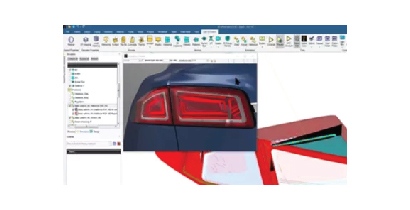
Automotive optical simulation covers headlamp beam pattern design, DRL/position light uniformity, interior ambient lighting, and photometric compliance with ECE and FMVSS regulations — from LED source to final light distribution on the road. Full system-level non-sequential ray tracing through the LED primary optic, reflector, projection lens, and outer lens correctly captures stray light, colour shift, and thermal-optical coupling — enabling regulatory compliance verification before any prototype lamp is built.
Industries Served
Deliverables
Key Aspects
Simulating the full headlamp optical system — LED source, primary optics, reflector, and projection lens — to design the low and high beam patterns to ECE R112 or FMVSS 108 requirements.
Optimising light guide geometry, LED pitch, and diffuser profiles to achieve luminance uniformity and intensity compliance for daytime running lights and position lamps.
Computing the test point values at all regulatory measurement points — verifying pass/fail against ECE and SAE standards before physical prototype measurement.
Evaluating LED junction temperature rise under operational conditions and its effect on luminous flux, colour shift, and optical performance — coupling photometric simulation with thermal CFD.
Connect with our optics & photonics simulation team to discuss the right approach for your application.