ANALYSIS TYPE / 04
Low Speed to High Speed
Overview
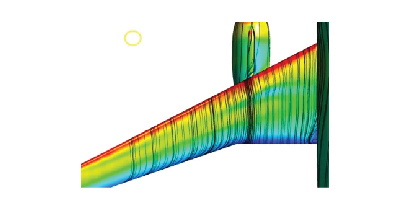
Subsonic Flow refers to fluid flow where the flow velocity is lower than the speed of sound, common in aerodynamics, ventilation systems, and low-speed fluid dynamics. Transonic Flow occurs when fluid flow transitions from subsonic to supersonic speeds, typically around the speed of sound, relevant in aerodynamics, turbomachinery, and aircraft design. CFD simulations help analyze shock waves, flow separation, and aerodynamic performance in transonic conditions. Supersonic Flow refers to fluid flow where velocity exceeds the speed of sound, encountered in high-speed aerodynamics, propulsion systems, and aerospace applications.
Industries Served
Deliverables
Other CFD Services
Multi Phase & Multi SpeciesThermal ManagementExternal & Internal AerodynamicsSubsonic / Transonic / Supersonic FlowsAero-Vibro AcousticsBattery Management SystemsFluid-Structure InteractionHydraulic & TurbomachineryCombustion & Reaction ChemistryPolymer & Metal ProcessingCustomized Functional DevelopmentKey Aspects
Solving incompressible or low-Mach compressible Navier-Stokes equations to predict pressure distributions, boundary layer development, and aerodynamic efficiency.
Using density-based solvers and appropriate flux schemes to accurately capture shock waves and shock-boundary-layer interactions in transonic regimes.
Modelling shock structure, expansion fans, and high-temperature real-gas effects for high-speed aerospace propulsion and re-entry vehicle applications.
Accounting for density variation, wave drag, and compressible mixing in flows where Mach number effects significantly alter the flow structure and performance.
Connect with our CFD engineering team to discuss the right approach for your application.