In real optical systems, image quality is often limited not by diffraction alone but by optical aberrations arising from lens geometry, alignment, and field dependence. Among third-order Seidel aberrations, coma aberration plays a crucial role in degrading off-axis image quality, producing comet-shaped blur patterns that are especially noticeable in imaging, astronomy, and automotive vision systems.
Modern optical design tools such as Ansys Zemax OpticStudio allow engineers to quantify, visualize, and correct coma efficiently during the design stage — reducing costly physical iterations.
Section 01What is Coma Aberration?
Coma is an aberration affecting off-axis object points, where rays passing through different zones of a lens fail to converge at a single image point. Instead of a sharp spot, the image appears asymmetric with a tail-like comet shape that increases with field angle. This distortion reduces spatial resolution, contrast, and measurement accuracy in imaging systems.
Coma arises primarily due to:
- Variation in magnification across the pupil
- Lens shape deviations from ideal imaging conditions
- Improper aperture stop position
- High field angles in wide field-of-view (FOV) systems
Mathematically, coma is a third-order aberration that increases rapidly for wide-angle optics — making coma control critical in any system with a broad FOV.
Section 02Visualizing Coma Using Ansys Zemax OpticStudio
One of the strongest advantages of Zemax is its ability to directly visualize aberrations through multiple analysis tools:
1. Spot Diagram Analysis
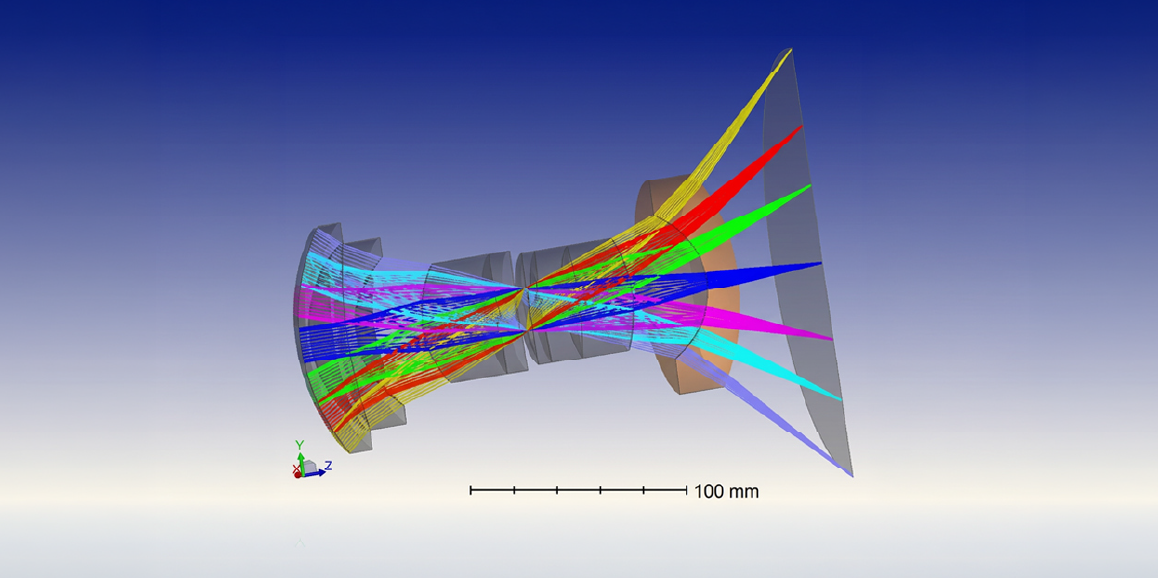
In Zemax, on-axis field points produce nearly circular diffraction-limited spots, while off-axis field points show a distinct comet-shaped spread. This provides immediate confirmation of coma presence.
2. Ray Fan Plot
The tangential and sagittal ray fans reveal asymmetry in transverse ray error and field-dependent growth of aberration — helping designers identify which surface contributes most to coma.
3. Wavefront Map & Zernike Terms
Zemax expresses coma via Zernike polynomial coefficients (primary coma: Z₇, Z₈; secondary coma for higher-order systems). Monitoring these values during optimization enables quantitative coma reduction.
Section 03Impact of Coma in Real Applications
Astronomy & Telescopes
Stars near the edge of the field appear stretched into comets, reducing observation clarity and making precise photometry difficult.
Automotive Camera Optics
Edge-field blur degrades object detection, lane recognition, and ADAS reliability — where sharp off-axis imaging is safety-critical.
Machine Vision
Measurement errors increase due to asymmetric point spread, directly impacting dimensional accuracy in quality inspection systems.
Section 04Zemax-Driven Strategies to Reduce Coma
1. Stop Position Optimization
Zemax allows rapid evaluation of entrance pupil shift and stop relocation, along with the resulting Seidel balance. Proper stop placement can significantly suppress coma. For a plano-convex lens, placing the aperture stop on the appropriate side of the lens notably reduces the geo radius values for off-axis field spots.
2. Lens Shape Bending
Using Zemax optimization, curvature distribution is tuned and coma contribution per surface is minimized. Two singlets with identical aperture, focal length, and material can exhibit very different coma performance depending on the lens bending achieved through optimization iterations.
3. Doublet-Based Optical Systems
Doublets or symmetric lens groups in Zemax introduce opposite coma contributions, enabling aberration cancellation while maintaining compact system length. A doublet lens pair is far superior to a singlet pair for coma correction — shown clearly through Zemax full-field aberration plots.
4. Aspheric Surface Introduction
Zemax makes it straightforward to add aspheric surfaces and optimize higher-order terms, achieving near-diffraction-limited off-axis performance. This is widely used in modern camera optics to attain image quality no spherical design can match.
Z₇, Z₈
Zernike primary coma terms
4
correction strategies in Zemax
3rd-order
Seidel aberration
Conclusion
Coma aberration is one of the most important factors affecting off-axis image quality in wide-field optical systems. Its presence can significantly degrade resolution and introduce distortions that impact applications ranging from astronomy to machine vision and automotive sensing.
Through advanced optical design software such as Ansys Zemax OpticStudio, engineers can perform detailed optical aberration analysis, identify the sources of coma, and implement systematic correction strategies. Mastering these techniques allows optical designers to achieve high image quality across the entire field of view while reducing development time and minimizing the need for physical prototyping.
Found this useful? Share it