In Part 1 of this blog series, we explored how simulation using Ansys Fluent enables accurate airflow prediction and IS 374-compliant performance assessment for ceiling fans — helping engineers optimise designs for better energy efficiency and air delivery without costly physical prototyping.
In Part 2 below, we dive deeper into fluid–structure interactions, blade optimization, acoustics, and simulation automation to complete the digital design workflow.
Section 01Fluid–Structure Interaction (FSI) Analysis of Ceiling Fan Blades
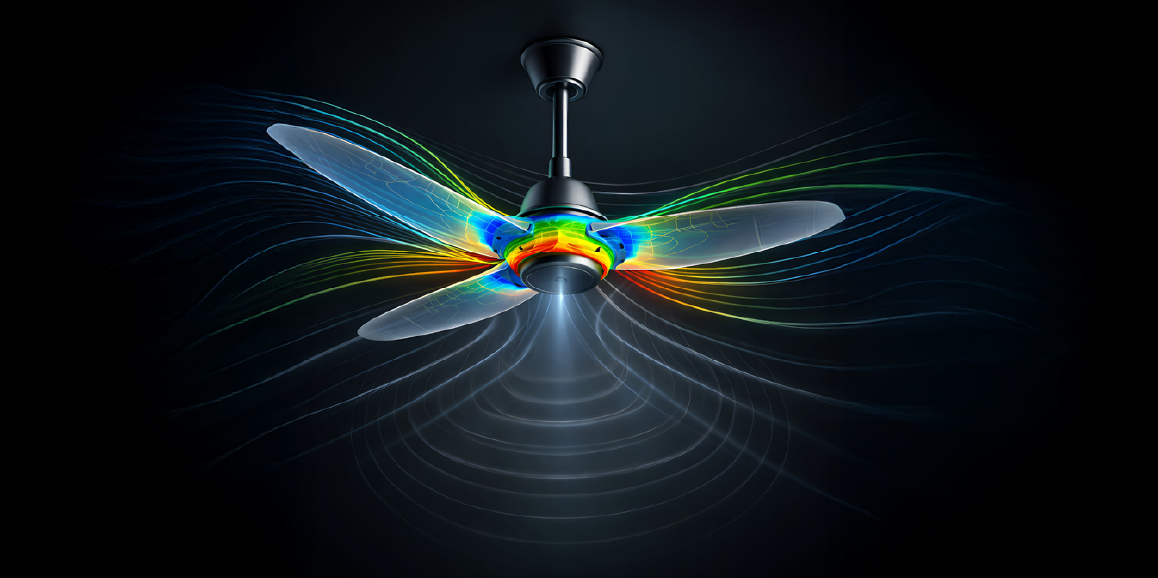
During operation, ceiling fan blades are not only subjected to aerodynamic loads but also to self-weight and centrifugal forces. If blade design lacks structural capacity, these loads can cause undesired deformation or failure. Under fluid loading, blades deform — changing their shape and, consequently, the airflow patterns they generate. This creates a coupled behaviour where the modified flow affects further blade deformation, making it critical to capture these interactions early in the design cycle.
One-Way vs Two-Way FSI
- 1-Way FSI — Transfers pressure data from the fluid solver to the structural solver to evaluate deformation due to fluid loads. It does not capture how the newly deformed shape alters the airflow characteristics.
- 2-Way FSI (System Coupling) — Through Ansys System Coupling, Ansys Fluent and Ansys Mechanical exchange data iteratively, predicting blade deformation under equilibrium conditions that include fluid pressure, self-weight, and centrifugal forces — offering a more realistic simulation of operational behaviour.
Section 02Shape Morphing Using Gradient-Based Optimisation
Designers seek blade profiles that maximise airflow and efficiency while maintaining structural integrity. Traditional parametric optimisation (e.g., DOE with Ansys optiSLang) can require significant computational resources. Gradient-based methods offer a more targeted path.
The Gradient-Based Approach
A gradient-based solver, typically using an adjoint method, computes the sensitivity of performance metrics (such as torque or drag) relative to geometric changes. This identifies the regions of the blade most sensitive to performance objectives — such as reducing torque or improving downward flow. Once sensitivity regions are known, shape morphing modifies the mesh locally to explore improved geometries.
The process iteratively:
- Identifies sensitive regions of the blade surface
- Morphs blade geometry in the direction of improvement
- Re-simulates performance on the updated geometry
- Repeats until optimal criteria are met
This method often reveals design improvements that traditional parameter sweeps might miss.
Section 03Blade Optimisation through Parametric Studies
In addition to gradient-based methods, multi-objective parametric optimisation (e.g., with Ansys optiSLang) enables systematic exploration of geometric variations against performance goals. These studies reveal trade-offs between torque, air delivery, and structural constraints to guide robust blade designs — particularly useful when multiple design variables interact non-linearly.
Section 04Acoustics Analysis of Ceiling Fans
Acoustics has become a key differentiator in modern consumer appliances. Ceiling fans are used for long durations, and prolonged exposure to unwanted noise can be uncomfortable for users. Fan noise can originate from multiple sources: air cutting by blades, vibration of fan components, and electric motor excitation.
Tonal and Broadband Noise
Fan noise can be classified as:
- Tonal noise — Discrete, high-amplitude signals at specific frequencies (multiples of the blade passing frequency).
- Broadband noise — Lower-amplitude, continuous sound spread across a wide frequency range from turbulent flow interactions.
Ceiling fans operate at relatively low rotational speeds, meaning most of their broadband noise falls within the human audible range of 20 Hz to 20 kHz.
Simulation-Driven Aeroacoustics
Conducting experimental acoustics studies can be time-consuming and expensive. Simulation provides an efficient alternative. Within CFD simulations, pressure monitors record time-dependent pressure fluctuations. These signals are post-processed using Fast Fourier Transformation (FFT) to analyse noise levels across frequencies.
To capture very small pressure variations — down to 2 × 10⁻⁵ Pa — scale-resolving turbulence models are required. Although computationally intensive, GPU-accelerated Ansys Fluent solvers significantly reduce turnaround time.
Sound Propagation Modelling Approaches
- Computational Aeroacoustics (CAA) — Resolves sound propagation directly by solving the Navier–Stokes equations; highest fidelity but most computationally demanding.
- Ffowcs-Williams and Hawkings (FWH) model — Integral method that solves wave equations for far-field noise prediction; good balance of accuracy and cost.
- Broadband noise models — Fast, steady-state-based directional noise estimates for early-stage screening.
Key Outputs of Aeroacoustics Analysis
- Pressure fluctuations with respect to time — processable via FFT into frequency-domain data
- Sound Pressure Level (SPL) in dB vs. frequency — identifies critical frequencies with high SPL
- A-weighted SPL (dBA) vs. octave bands and 1/3rd octave band frequencies
- Acoustic source identification using DFT analysis
- Audio data from the acoustic signal — can be played back to understand real-time perception
FWH
far-field noise model
FFT
frequency domain analysis
dBA
A-weighted SPL metric
Section 05IS 374 Air Delivery Testing Automation Using PyFluent
As simulation workflows grow more complex, automation becomes essential for productivity. IS 374 air delivery testing must be conducted for multiple blade designs, making manual setup repetitive and time-consuming.
Using PyFluent, the entire IS 374 simulation workflow can be automated — from model setup and execution to post-processing — ensuring consistency while significantly reducing overall analysis time. This approach is particularly valuable when evaluating design variants, where the same boundary conditions and solver settings must be applied repeatedly with precision.
Conclusion
Designing an efficient and reliable ceiling fan requires more than optimising airflow alone. By integrating fluid–structure interaction, blade optimisation, aeroacoustics, and simulation automation, engineers can realistically evaluate blade deformation, improve performance, reduce noise, and accelerate design validation.
Together with the aerodynamic insights from Part 1, these advanced Ansys simulation techniques enable a holistic, physics-based approach to ceiling fan design — supporting better engineering decisions with reduced reliance on physical prototyping.
Found this useful? Share it