Engineering Efficient Airflow: How Simulation Improves Ceiling Fan Design
Ceiling fans remain one of the most widely used air ventilation solutions in households. See how Ansys Fluent models airflow and energy consumption so engineers can fine-tune blade design and motor specifications.
MG
Mangesh Shahji Gavede
Jun 6, 20256 min read
Introduction
Ceiling fans remain one of the most widely used air ventilation solutions in households due to their energy efficiency compared to air conditioning systems. Consisting primarily of a motor and rotating blades, ceiling fans work by displacing air to create airflow. As their use continues to grow, improving the energy efficiency of ceiling fans is becoming increasingly important—both for environmental and regulatory reasons.
We leverage Ansys technologies and simulation-driven design to optimize ceiling fan performance. By digitally modeling airflow and energy consumption, engineers can fine-tune blade design and motor specifications to achieve higher energy star ratings and improved operational efficiency.
Section 01Importance of Optimized Blade Design
While advancements in motor technology have significantly boosted efficiency, the design of the fan blades also plays a crucial role. Optimized blade shapes reduce drag and improve air displacement, contributing to better overall performance. This makes simulation a key tool for achieving higher efficiency without the need for repeated physical prototypes.
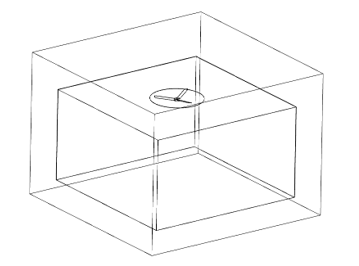
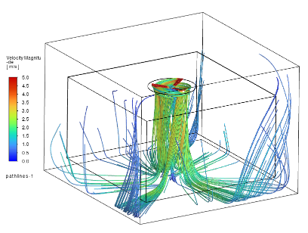
Fig 1 : Simulation domain
Section 02IS 374: Standard Test for Air Delivery
The IS 374 standard outlines a structured method to assess the air delivery performance of ceiling fans:
The fan is installed in an enclosed test chamber at the center of the room.
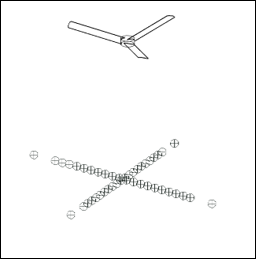
Once the fan reaches steady-state operation, air velocity is measured at a height of 1.5 meters directly below the fan.
Measurements are taken at four points along each concentric circle at regular radial intervals, continuing until the velocities drop below the threshold defined by the IS 374 standard.
The average velocity at each circle is multiplied by its corresponding annular area, and these values are summed to compute the total air delivery.
Traditionally, testing different blade designs requires physical prototyping, which can be time-consuming and costly. With Ansys Fluent, digital prototypes allow engineers to simulate and validate blade designs efficiently.
Fig 2 : Velocity measurement location
Section 03Using Ansys Fluent for Airflow Simulation
Ansys Fluent is a leading CFD (Computational Fluid Dynamics) software that enables detailed simulation of fluid, thermal, and chemical behaviours. For ceiling fans:
Turbulent Flow Modelling: Ceiling fan airflow is typically turbulent. Ansys Fluent supports various turbulence models, including RANS (Reynolds-Averaged Navier-Stokes) for time-averaged results and LES (Large Eddy Simulation) for more detailed analysis.
MRF (Multiple Reference Frame) Technique: MRF is a steady-state method that models rotating components without the cost of full transient simulation. It is ideal for air delivery estimation in ceiling fans.
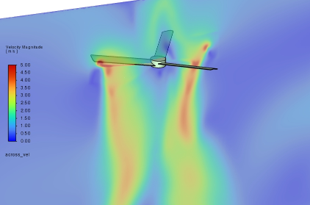
Simulation results align closely with IS 374 test data, validating the effectiveness of this approach.
Section 04Additional Insights from Flow Analysis
Beyond estimating air delivery, Ansys Fluent simulations provide valuable data:
Torque Estimation: Torque required to rotate blades at a certain RPM can be calculated from pressure distribution on the blades.
Motor Selection: Torque and RPM values help determine appropriate motor power ratings.
Power Consumption: Enables calculation of energy use based on torque and operational speed.
IS374 test simulations usually takes couple of hours of simulation time with parallel CPU cores but now with the introduction of Fluent GPU solver a ~10X scalability can be observed which can bring down the simulation time to couple of minutes. Such scalability along with Ansys optimization technology can accelerate the blade design optimization tremendously.
Section 05Summary: Key Outcomes of Simulation-Driven Fan Design
Accurate air delivery estimation as per IS 374 standards.
Torque and power calculation for motor design.
Ability to map pressure loads for structural analysis of blades.
Faster design cycles with GPU-accelerated solvers.
Efficient handling of complex geometries with FTM.
Section 06Advanced geometry capturing technology with Ansys fluent meshing
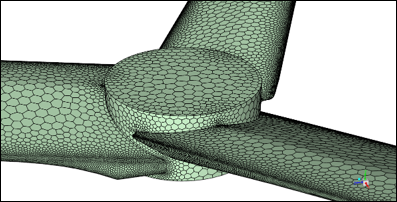
With the advancement in technology complex blade profiles are being considered for analysis. Clean up of such complex blade geometries for simulation can be challenging & time consuming. Fault-tolerant meshing within Ansys fluent meshing can capture such complex geometry using wrapper technology. Dirty blade geometries with slivered faces, gaps or overlapping geometry can be easily captured with the various options within FTM like leakage threshold, local wrapper sizing & intersection loop.
Key Features and Benefits:
Handles Imperfect Geometries: FTM can handle geometries that are not watertight, meaning they may have gaps, overlaps, or other imperfections that would typically cause meshing to fail.
Reduces Geometry Preparation: By automatically addressing these imperfections, FTM minimizes the time and effort required for geometry clean-up and repair, allowing users to focus on the simulation.
Wrapper Technology: FTM utilizes a "wrapper" that effectively seals off leakages and gaps in the geometry, creating a clean, watertight representation for meshing.
What’s Next?
In the next part of this blog series, we’ll explore:
Structural analysis of fan blades using fluid-structure interaction.
Blade profile optimization through parametric and gradient-based morphing.
Acoustic simulation for predicting ceiling fan noise.
Stay tuned to learn how simulation is powering the next generation of quiet, efficient, and sustainable ceiling fans.
Found this useful? Share it
Continue Reading
More from our engineers.
If this article was useful, these picks up where it leaves off — practical reads from the CADFEM engineering practice.