
Predict Faster. Decide Smarter. Experiment Less.
An AI-powered engineering intelligence platform that enables engineers to connect simulation data, machine learning models, optimization methods, and workflow automation within a single visual environment. Designed for engineering and scientific applications, it helps organizations accelerate decision-making, reduce experimentation, automate repetitive tasks, and improve prediction accuracy using Physics AI, Generative AI, and Agentic AI.
Why STOCHOS Flow
Predict Faster
Decide Smarter
Experiment Less
Automate Engineering Workflows
What Problems Does STOCHOS Flow Solve
Engineering Data Silos
Engineering data often exists across simulations, test systems, spreadsheets, databases, and sensors.
STOCHOS Flow automatically integrates, prepares, and organizes data into unified workflows, enabling faster analysis and decision-making.
Long Simulation Cycles
High-fidelity simulations provide valuable insights but often require significant computational time.
Physics AI creates predictive models that generate engineering predictions in seconds while maintaining engineering relevance.
Slow Optimization Studies
Traditional optimization workflows may require hundreds or thousands of simulations.
Bayesian Optimization intelligently identifies promising design candidates using significantly fewer evaluations.
Repetitive Engineering Tasks
Engineers frequently spend time on data preparation, scripting, workflow setup, and result processing.
Agentic AI automates repetitive activities while maintaining full transparency and user control.
Manual Report Generation
Creating engineering reports and presentations can consume valuable engineering resources.
Automated reporting workflows generate technical summaries, visualizations, and documentation directly from engineering workflows.
Core AI Technologies
Three AI Engines. One Platform.
Combines engineering knowledge with probabilistic machine learning to create reliable predictive models from simulation and experimental data.
How It Works
- Learns complex engineering relationships from available data
- Quantifies prediction uncertainty
- Combines simulation and experimental datasets
- Supports optimization and design exploration
Why Engineers Use It
- Faster engineering predictions
- Reduced simulation effort
- Improved design exploration
- Greater confidence in engineering decisions
Key Capabilities
- Probabilistic AI
- Bayesian Optimization
- Multi-Fidelity Modeling
- Sensitivity Analysis
Enables engineers to create workflows, automate engineering tasks, and interact with engineering systems using natural language.
How It Works
- Assists workflow creation
- Generates automation logic
- Supports conversational engineering interaction
- Accelerates design exploration
Why Engineers Use It
- Faster workflow development
- Reduced manual effort
- Simplified automation
- Improved engineering efficiency
Key Capabilities
- AI-Assisted Workflow Creation
- Natural Language Interaction
- Generative Engineering Workflows
- Intelligent Design Exploration
Intelligent assistants capable of executing multi-step engineering tasks, coordinating workflows, and supporting engineering decision-making.
How It Works
- Uses memory, planning, and tool orchestration
- Automates data preparation and scripting
- Supports workflow execution
- Generates engineering insights and reports
Why Engineers Use It
- Reduced engineering effort
- Faster workflow execution
- Improved process consistency
- Increased engineering productivity
Key Capabilities
- LLM Agents
- Smart Workflow Nodes
- AI-Assisted Scripting
- Automated Reporting
- Custom AI Agents
How STOCHOS Flow Works
Engineering Intelligence Built for Engineers
Visual Workflows
Build engineering workflows on an interactive node-based canvas where every step remains transparent, editable, reusable, and fully traceable.
Conversational Engineering
Use natural language to create workflows, generate scripts, configure AI models, and automate engineering tasks.
Intelligent AI Agents
AI agents assist engineers throughout the workflow lifecycle, supporting data preparation, optimization, workflow execution, scripting, and reporting.
Secure Local Deployment
Deploy STOCHOS Flow on local infrastructure without mandatory cloud connectivity, ensuring complete control over engineering data, intellectual property, and security requirements.
Engineering Data Compatibility
Simulation Data
Import CFD, FEA, electromagnetic, optical, and multiphysics simulation results to build predictive engineering models.
Experimental Data
Leverage laboratory measurements and validation data to improve model accuracy and reliability.
Sensor & Time-Series Data
Analyze operational data for forecasting, monitoring, and predictive decision-making.
Images & Inspection Data
Process image-based engineering information for classification, quality assessment, and analysis.
Graph & Network Data
Build AI workflows for connected engineering systems and complex relationships.
Engineering Databases
Connect spreadsheets, databases, and enterprise systems into unified engineering workflows.
Engineering Productivity Tools
Python-Powered Flexibility
A dedicated Python environment enables custom calculations, preprocessing, data transformation, analysis, and workflow automation with AI-assisted scripting support.
Benefits
- Full scripting flexibility
- AI-assisted code generation
- Reusable workflow components
- Seamless workflow integration
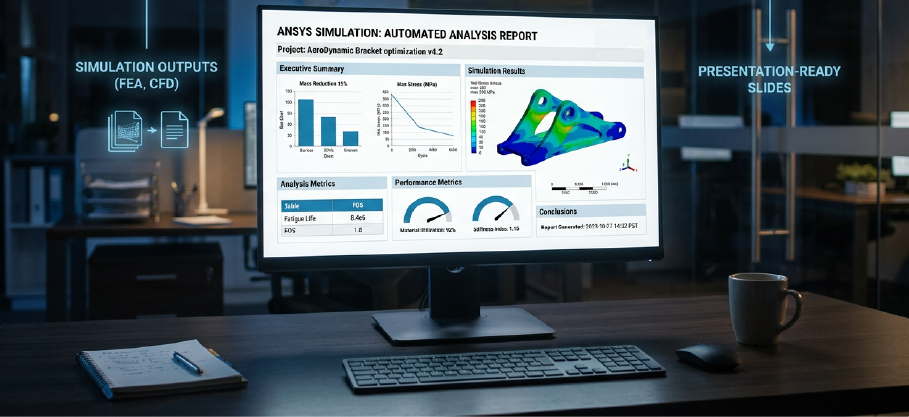
Automated Report Generation
Generate engineering reports and presentations directly from workflow outputs.
Capabilities
- Automated report creation
- Customizable templates
- Analysis-driven summaries
- Visualization generation
- 3D simulation result interpretation
Who Should Use STOCHOS Flow
Simulation Engineers
Build surrogate models, automate workflows, and accelerate simulation-driven engineering decisions.
Product Development Teams
Explore design alternatives faster using predictive models, optimization methods, and AI-driven insights.
Digital Twin Teams
Connect simulation, operational, and sensor data to improve predictive capabilities and system understanding.
Data Scientists & AI Engineers
Develop engineering-focused AI workflows using simulation, experimental, and operational data.
Manufacturing & Process Engineers
Optimize production processes and operational performance using engineering intelligence.
R&D Organizations
Accelerate experimentation, reduce development cycles, and improve innovation productivity.
Industry Applications
Product Development
Accelerate design exploration, virtual validation, optimization, and performance prediction throughout the product lifecycle.
Manufacturing Optimization
Improve process performance, production efficiency, and operational decision-making through predictive engineering workflows.
Semiconductors & Electronics
Combine simulation, measurement, and operational data to accelerate design validation and technology development.
Aerospace & Defence
Reduce engineering risk and accelerate development through simulation-driven AI models and automated workflows.
Energy & Industrial Systems
Improve reliability, optimize performance, and support predictive maintenance using engineering intelligence.
Scientific Research
Accelerate experimentation, reduce computational effort, and uncover insights through AI-assisted engineering workflows.
STOCHOS Flow vs Traditional
Engineering Workflows
Why CADFEM
CADFEM combines deep engineering expertise, simulation knowledge, and AI-driven innovation to help organizations successfully implement engineering intelligence solutions. From deployment and training to workflow development and long-term support, our experts help teams maximize value from simulation, data, and AI technologies.
Frequently Asked Questions
What is STOCHOS Flow?
STOCHOS Flow is an AI-powered engineering intelligence platform that combines simulation, machine learning, optimization, and workflow automation within a single visual environment.
What is Engineering Intelligence?
Engineering Intelligence combines simulation, data, AI, and automation to help engineers make faster, more informed decisions across product development, manufacturing, and research activities.
What is Physics AI?
Physics AI combines engineering knowledge and machine learning to build predictive models from simulation and experimental data while quantifying prediction uncertainty.
What is Agentic AI?
Agentic AI uses intelligent assistants capable of planning, scripting, data preparation, workflow orchestration, and engineering automation to support engineers throughout the workflow lifecycle.
How does AI reduce simulation time?
AI models learn relationships from simulation data and generate accurate predictions without requiring a full simulation for every new design iteration.
What is a surrogate model?
A surrogate model is an AI-based approximation of a simulation or experiment that delivers results significantly faster while maintaining useful engineering accuracy.
What is Bayesian Optimization?
Bayesian Optimization is a data-efficient optimization method that intelligently selects the most valuable next simulation or experiment to identify optimal solutions faster.
How do engineering teams use Physics AI?
Engineering teams use Physics AI to accelerate design exploration, predict system behavior, perform sensitivity analysis, and reduce simulation effort during product development.
Can STOCHOS Flow work with CFD and FEA data?
Yes. STOCHOS Flow supports CFD, FEA, electromagnetic, optical, and multiphysics simulation data alongside experimental and operational datasets.
Does STOCHOS Flow support Python?
Yes. A dedicated Python environment enables custom analysis, preprocessing, automation, and workflow development with AI-assisted scripting capabilities.
Can STOCHOS Flow run on local infrastructure?
Yes. STOCHOS Flow supports local deployment, providing complete control over engineering data, intellectual property, and security requirements.
What industries use STOCHOS Flow?
STOCHOS Flow supports applications across product development, manufacturing, semiconductors, aerospace, automotive, energy, industrial engineering, and scientific research.