System Safety Analysis for Railway Applications using Ansys Medini Analyze
System Safety Analysis in railways identifies, evaluates and mitigates hazards across the lifecycle to meet EN 50129 and EN 50126. Ansys Medini Analyze provides an integrated, model-based environment for FMEA, FTA, HAZOP and FMEDA linked directly to system design.
HA
Harsh & Ashok
May 23, 20256 min read
System Safety Analysis (SSA) in railways is a structured process to identify, evaluate, and mitigate hazards throughout the lifecycle of railway systems. It ensures compliance with standards like EN 50129 (Safety-related electronic systems) and EN 50126 (RAMS – Reliability, Availability, Maintainability, and Safety), help achieve required Safety Integrity Levels (SIL). Ansys Medini Analyze plays a pivotal role in this by providing an integrated, model-based environment for conducting safety, reliability, and risk assessments. It supports methods such as FMEA, FTA, HAZOP, and FMEDA—all directly linked to system design. With Ansys Medini Analyze, safety engineers can efficiently perform functional safety analysis aligned with software-controlled, safety-critical functions in modern rail systems.
EN 50129 – Safety of Electronic Systems
EN 50129 provides specific requirements for the safety assessment and clarification of safety-related electronic systems used in railway signaling. It focusses on:
Functional Safety
Safety lifecycle management
Evidence of compliance with allocated SIL's
System Safety Analysis under EN50129 involves:
Preliminary Hazard Analysis
Functional Hazard Analysis
Failure Mode and Effects analysis (FMEA)
Fault Tree Analysis (FTA)
Requirements definition
Failure Mode and Effects Criticality Analysis
Objectives of System Safety Analysis:
Hazard Identification: Detect all hazards that could lead to unsafe system conditions.
Risk Assessment: Evaluates the severity and frequency of each hazard, leading to risk clarification.
Risk Mitigation: Define safety measures and design controls to reduce risk to acceptable levels.
Documentation: Maintain a structured safety case that complies all safety – related evidence in compliance with EN 50129.
EN 50126 – RAMS Lifecycle Framework
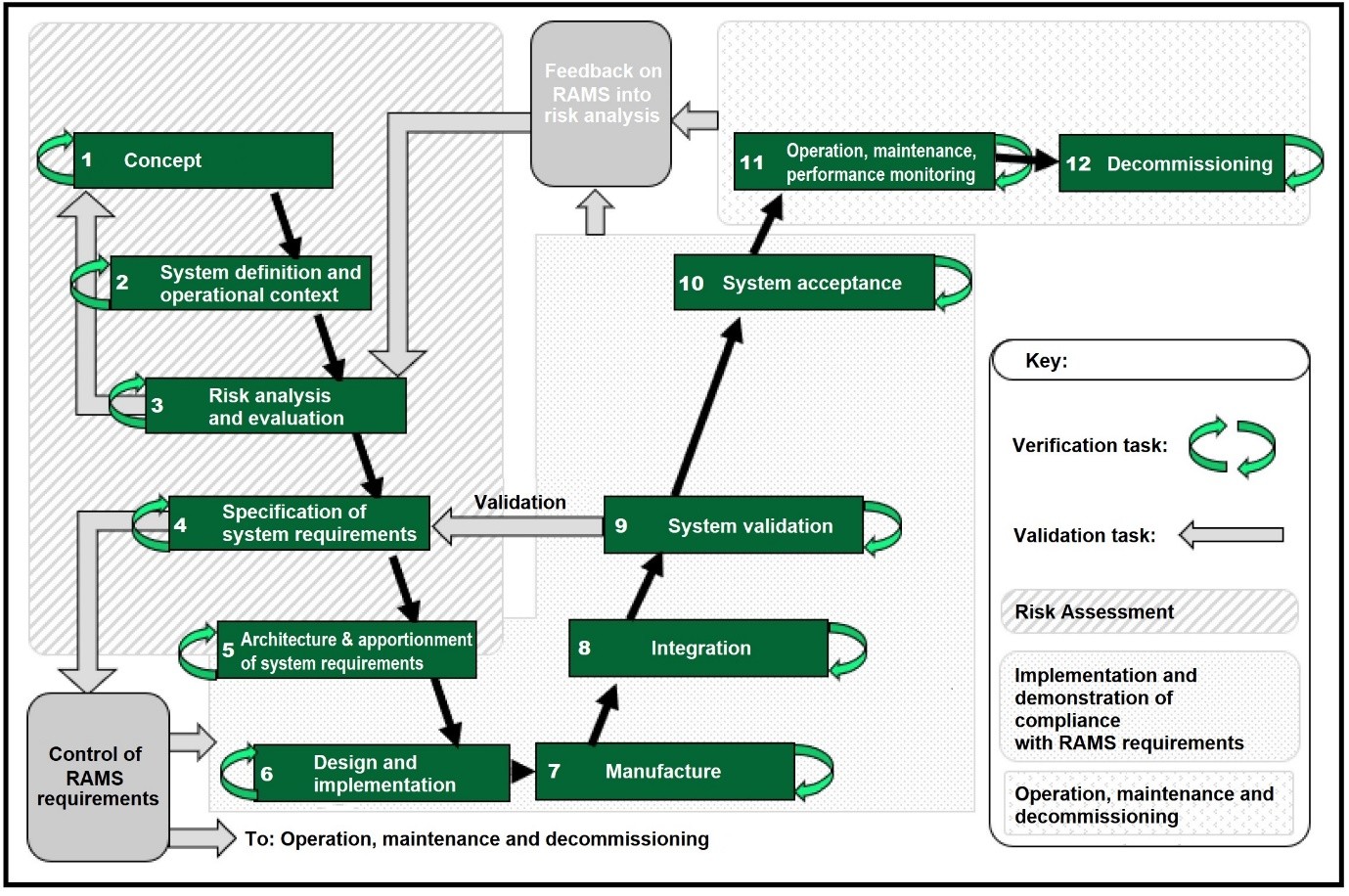
EN 50126 defines the overall RAMS lifecycle for railway applications. It emphasizes a lifecycle approach to safety, beginning with concept and definition phases and extending through design, implementation, operation, maintenance, and eventual decommissioning. System safety analysis is integrated throughout this lifecycle to ensure continuous hazard identification and risk management
Definition of system functions and performance requirements.
Hazard identification and risk classification.
Allocation of safety responsibilities and target safety integrity levels (SILs).
Traceability and verification of safety requirements.
RAMS Workflow
Key Points:
1. Concept Phase
In concept phase, the overall goals of our system, stakeholder needs, and feasibility of the railways system are defined. Safety, availability, and reliability objectives are established as part of the high-level RAMS targets.
2. System Definition and Operational Context
This phase defines system boundaries, interfaces, functions, and the intended operational environment. It ensures all external factors and interactions influencing system safety are identified and documented.
3. Risk Analysis and Evaluation
System hazards are identified and assessed using structured techniques (e.g., PHA, FHA). Risks are evaluated against predefined safety criteria, and target safety integrity level (SILs) are determined.
4. Specification of System Requirements
Safety, functional, and RAMS requirements are specified ensuring they are complete, verifiable, and traceable. These requirements serve as the basis for design and subsequent verification.
5. Architecture and Apportionment of System Requirements
System Requirements are allocated to subsystems and components, considering redundancy, independence, and safety architecture. The design is structured to meet SIL targets and mitigate hazards.
6. Design and Implementation
Detailed design and coding are carried out according to the allocated requirements. This phase includes integration and unit testing, ensuring that the system meets both functional and safety objectives.
Ansys Medini Analyze for Railways System Safety Analysis
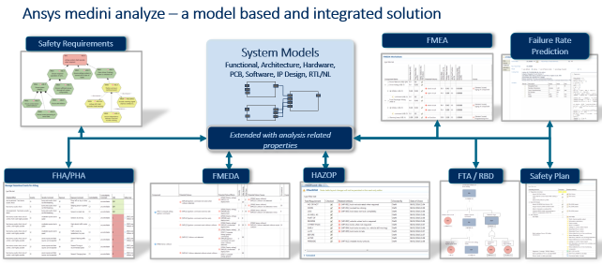
Ansys Medini Analyze is a functional safety electronic system analysis software is a model based and integrated toolset. It supports the safety analysis and design for software controlled safety critical functions. Conceptually, safety engineers shall be able to seamlessly analyze the safety and reliability characteristics of the model that are created during system engineering. If these models are not available, they can be created directly inside the software.
The rationale of safety analysis methods such as Hazard Assessment and Risk Analysis (PHA, FHA), HAZOP/Guideword Analysis, FMEA/FMECA, FMEDA and FTA is that those shall provide a dedicated analysis view on the design, so that the safety analysis is not conducted in a decoupled manner but directly connects to the design.
Key Concepts:
SysML Models: To represent the boundary diagram with the key components using SysML Format
PHA: Preliminary Hazard Analysis (PHA) is an early-stage safety analysis technique used to identify potential hazards, their causes, and consequences in a system, process, or product design—before full development or implementation.
FHA: Functional Hazard Assessment (FHA) is a key method used to analyze what can go wrong with system functions and determine how severe the consequences would be. This assessment is critical in deriving Safety Integrity Levels (SILs) — a measure of risk reduction required for safety functions, primarily under standards like EN50126/EN50129, IEC 61508.
HAZOP/Guideword Analysis: Hazard and Operability Study is a method used to analyze the malfunctioning behaviour for the system level and subsystem level functionalities in the early stage of development.
FMEA: Failure Modes and Effects analysis is a method to define the potential Failure Causes, Potential failure effects and the Risk Priority Number.
FMEDA: Failure Modes and Effects Diagnostic Coverage is a method to define the safe faults and Safe failure fraction percentage with diagnostic coverage.
FTA/RBD: Fault Tree Analysis is a methos to derive the Minimal cut sets, mean time calculations and Probabilities calculation. Reliability Block diagram is a method to derive the reliability for each subsystem and System.
Conclusion
The RAMS analysis conducted using ANSYS Medini Analyze provided a structured and integrated approach to evaluating system reliability, availability, maintainability, and safety. By combining techniques such as FHA, FMEA, FMEDA, FTA, RBD, and HAZOP within a single tool, the analysis ensured consistency and traceability throughout the system lifecycle. Medini's support for industry standards like ISO26262, IEC61508, EN50126/EN50129 facilitated compliance and certification readiness. The model-based environment enabled early hazard identification and efficient risk mitigation. Quantitative evaluations of failure rates and safety integrity levels were streamlined through automated tools and built-in libraries. Overall, Medini enhanced the accuracy, efficiency, and completeness of the RAMS process.
Found this useful? Share it
Continue Reading
More from our engineers.
If this article was useful, these picks up where it leaves off — practical reads from the CADFEM engineering practice.