Understanding gRPC-Based Python-Ansys Integration: Enabling Smart Engineering Solutions with PyAnsys
A look at the gRPC architecture behind PyAnsys, the key libraries in the ecosystem, and why engineers use Python to automate, customize and scale Ansys simulations.
NB
Naveen Kumar Begari
Jun 2, 20255 min read
Before we dive into using the Ansys Python Manager, it's helpful to understand the backend architecture that powers the PyAnsys ecosystem. Gaining insight into how this technology works behind the scenes will provide valuable context for how the tools interact, communicate, and deliver powerful simulation capabilities through Python.
In today's fast-paced engineering and simulation landscape, automating, customizing, and scaling workflows is crucial. Integrating Python with Ansys — powered by gRPC and the PyAnsys ecosystem — combines flexibility and advanced simulation to streamline processes, enable cross-platform communication, and create specialized applications. From automating design variations to generating AI-ready datasets, PyAnsys delivers a powerful toolkit for efficient, scalable engineering solutions.
Section 01Seamless Integration of Python and Ansys Using gRPC APIs
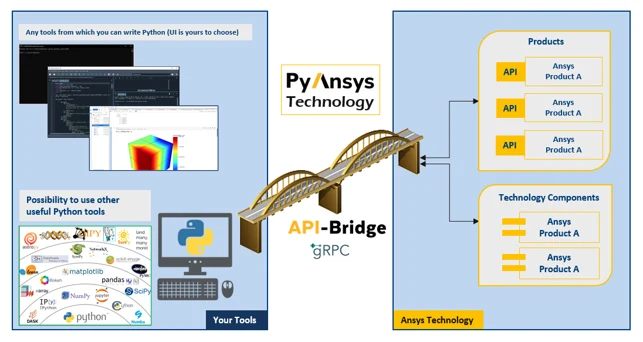
In the world of engineering simulations and automation, efficient communication between software tools is crucial. gRPC (Google Remote Procedure Call) provides a high-performance, language-agnostic framework that enables seamless interaction between Python and Ansys.
Why gRPC?
Fig 1 · PyAnsys as a gRPC API bridge between your Python tools and Ansys technology
Key advantages of gRPC over traditional REST APIs include:
High-speed data exchange using compact Protocol Buffers
Low latency, suitable for real-time or high-frequency operations
Bidirectional streaming for efficient data transfer
Bridging Python and Ansys with gRPC
By leveraging gRPC-based APIs, Python can seamlessly interact with Ansys software, enabling:
Remote execution of simulations
Automated workflows for engineering processes
Efficient data exchange between applications
This integration enhances speed, scalability, and flexibility, making it ideal for modern engineering applications that require automation and real-time processing.
Section 02Key Libraries in the PyAnsys Ecosystem
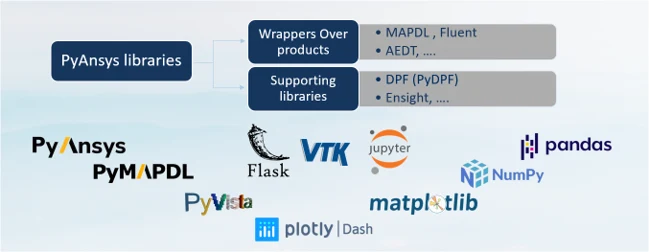
The PyAnsys ecosystem consists of several libraries tailored to specific Ansys capabilities. Each of these libraries offers powerful features for different types of engineering simulations:
Fig 2 · PyAnsys product wrappers and supporting libraries
Section 03PyAnsys Ecosystem
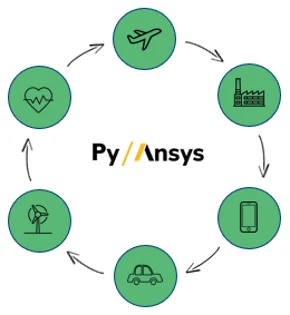
In collaborating with users across various industries, I've encountered a wide range of applications for PyAnsys. These include automating entire workflows for design variations, generating large datasets for machine learning, developing custom post-processing routines, and building specialized vertical applications — such as those tailored for the healthcare sector.
Fig 3 · PyAnsys across industries
Section 04Why Should You Use PyAnsys?
1. Ease of Automation
Automating repetitive tasks, such as parameter studies, optimization, and reporting, is a breeze with PyAnsys. Python scripts help reduce manual effort, saving both time and resources while enhancing overall productivity.
2. Custom Workflows
PyAnsys allows users to design custom workflows tailored to their specific simulation needs. Whether you're running simulations or processing results, you can structure your workflow to suit the problem at hand.
3. Seamless Integration with the Python Ecosystem
PyAnsys integrates with Python's rich ecosystem of libraries — such as NumPy, Pandas, and Matplotlib — to enhance your data processing, analysis, and visualization capabilities.
4. Scalability
Whether you're running simulations on local machines, leveraging high-performance computing (HPC) clusters, or scaling up to cloud platforms, PyAnsys allows for seamless scalability, making it perfect for handling large, complex problems.
5. Open-Source and Community-Driven
PyAnsys is open-source, which means users can not only benefit from its features but also contribute to its development. The community-driven nature of PyAnsys ensures continuous improvement and a broad base of support.
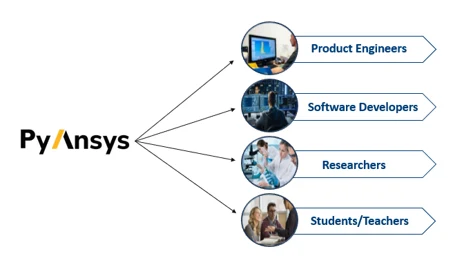
PyAnsys is particularly useful for:
Fig 4 · Who PyAnsys is for
Section 05Applications of PyAnsys
1. Structural Analysis
Automate finite element analyses (FEA), perform parameterized models, and run design optimizations to improve structures' performance.
2. CFD Simulations
Use PyAnsys for computational fluid dynamics (CFD), running parametric studies on fluid flows and visualizing results programmatically for better decision-making.
3. Electromagnetics
Optimize the design of antennas, PCB layouts, and RF systems with PyAnsys support for electromagnetic simulations.
4. Material Studies
Integrate material databases into your workflows to perform advanced material selection, ideal for simulations requiring precise material properties.
5. Academic Research
PyAnsys is widely used in academic research, helping scholars conduct simulation-based research to uncover new insights and make advances in various engineering fields.
Note: All the modules are available in the PyAnsys documentation at PyAnsys.
Conclusion
Integrating Python with Ansys via gRPC and the PyAnsys ecosystem represents a major leap forward in engineering simulation workflows. This integration leverages Python's versatility alongside Ansys's robust simulation power, enabling seamless automation, tailored customization, and scalable solutions to address the demands of today's rapid engineering landscape.
In the upcoming blog, we will explore Ansys Python Manager — what it is, its purpose, and how it simplifies working with Ansys using Python. Stay tuned!
Need support in automating your project? Looking to learn through hands-on workshops?