What Is a Battery Management System? Guide for Automotive Applications
Read the CADFEM guide to smart BMS functions, automotive thermal management, centralized vs. modular architectures, and Ansys simulation
Read Article →
Geometry-Based Adaptivity in FEA provides an efficient way to automatically refine the mesh during solving, ensuring optimal accuracy while minimizing computational costs.
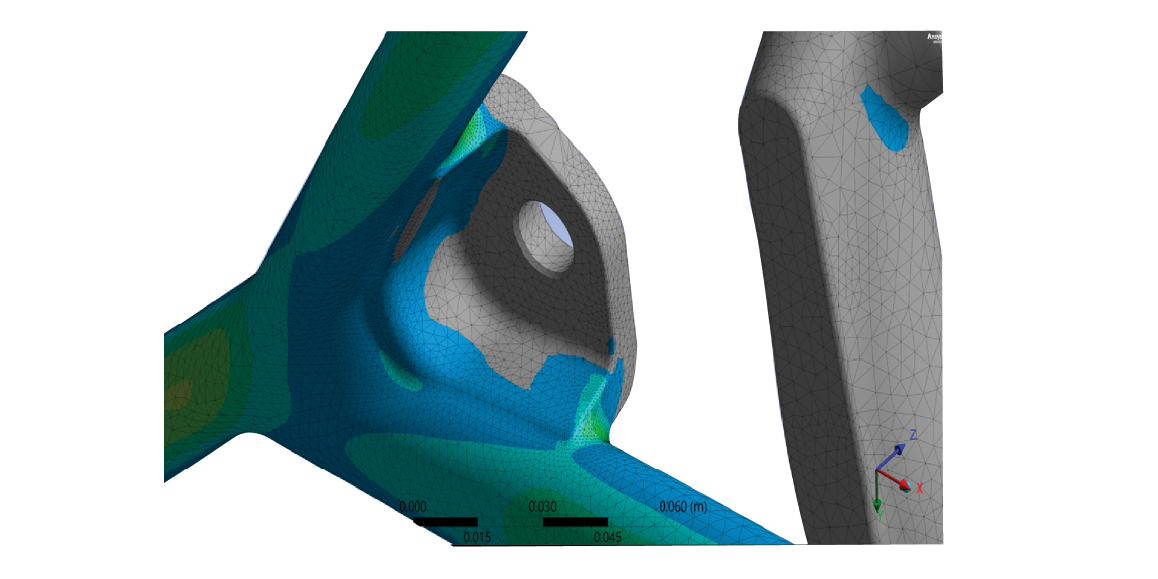
Finite Element Analysis (FEA) is a powerful numerical method used to solve complex engineering problems involving intricate geometries, varying loading conditions, and boundary constraints. In FEA, a continuous domain is discretized into smaller finite elements, a process known as meshing. The accuracy of simulation results largely depends on how well the mesh captures the geometric features and maintains element quality.
To accurately represent fine details, engineers often use high-quality or fine mesh, but this comes at the cost of increased computational time and resource consumption. Complex geometries are particularly challenging to mesh with standard settings, often leading to compromised quality or excessive element count.
To address these challenges, Geometry-Based Adaptivity in FEA provides an efficient way to automatically refine the mesh during solving, ensuring optimal accuracy while minimizing computational costs. This feature intelligently adjusts the mesh to better capture topological details without requiring excessive manual intervention.
Adaptivity in FEA involves dynamic mesh refinement during the solution process to improve accuracy. It uses an iterative feedback mechanism that updates internal mesh parameters either discretely or continuously, ensuring convergence and precision.
There are two primary adaptivity techniques:
This technique helps reduce convergence issues in nonlinear analyses caused by element distortion. It remeshes the model based on initial mesh boundaries, meaning that a fine mesh is required from the start to capture geometric details.
Unlike the Nonlinear Adaptive Region, which remeshes within the initial mesh structure, Geometry-Based Adaptivity creates new nodes and elements along the actual geometry boundaries. This eliminates the need for an initial fine mesh, significantly reducing computational overhead while improving accuracy.
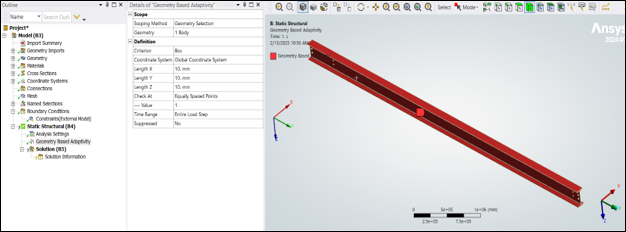
Geometry preserving adaptivity will be applicable to all the static analysis with Geometric nonlinearity turned off. This condition supports linear and quadratic tetrahedral elements. An assembly that includes both linear and quadratic elements cannot be used. Two criterions will be applicable to geometry preserving adaptivity, Energy and Box.
This criterion checks the strain energy of elements considered for this criterion and compares with mean strain energy of the component to which this element belongs. Mesh refinement will take place only when this criterion will be satisfied at a particular element. This criterion applied to areas having high stress concentration and elements are too large to attain high-accuracy simulation. Strain energy for each element is calculated and criterion will be checked using following equation.
Ee ≥ c1 × ETotal / NUME
Where:
If this criterion is satisfied at an element, the program refines the element. A smaller Energy Coefficient improves the potential to trigger the mesh regeneration for the same loads.
This criterion is based on user defined box creation; a region is defined in the global or local coordinates. If all nodes of an element are within the user defined region, the element is either refined via general remeshing or it is split based upon element type. If Box is selected, the following additional properties require entries:
This method is particularly useful when targeting specific regions for refinement instead of refining the entire model.
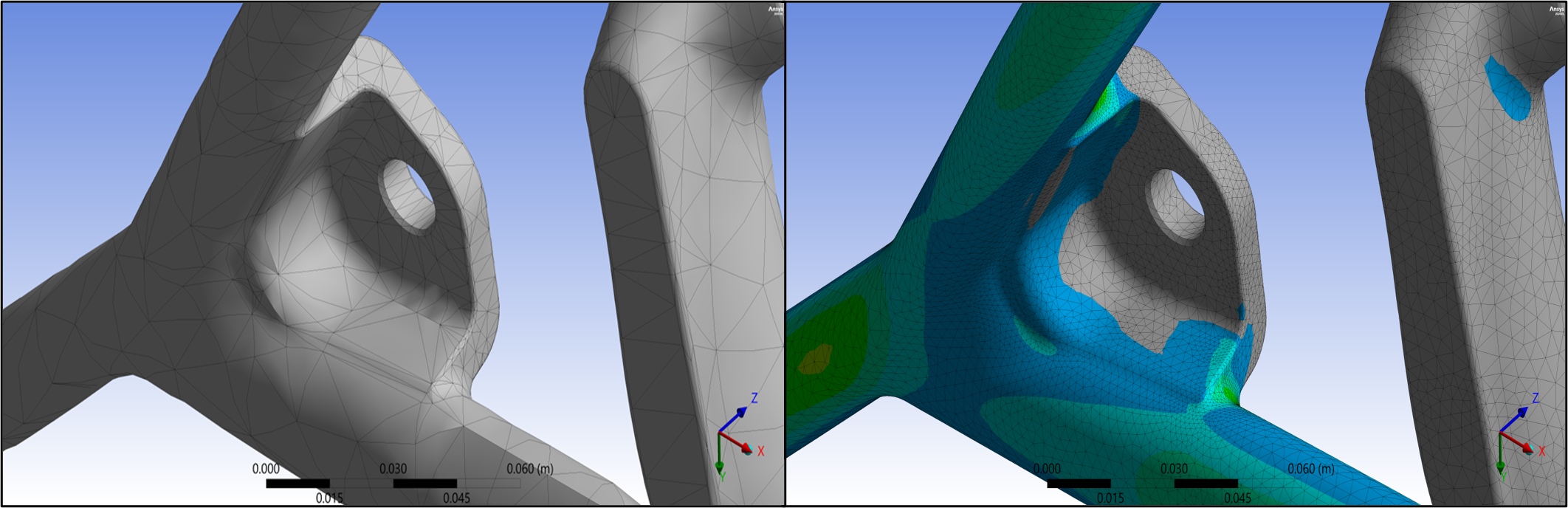
Optimizing mesh accuracy and computational efficiency is a fundamental challenge in FEA. Geometry-Based Adaptivity presents a game-changing solution by dynamically refining the mesh only where needed, eliminating the need for excessive manual intervention.
By automatically adjusting element density based on energy concentration and geometric features, this approach ensures that simulations are both accurate and computationally efficient. As industries continue to push the limits of engineering complexity, Geometry-Based Adaptivity will remain a crucial tool for achieving high-fidelity simulations without excessive computational costs.
 Multi Physics
Read the CADFEM guide to smart BMS functions, automotive thermal management, centralized vs. modular architectures, and Ansys simulation
Read Article → Structures
Di tengah pesatnya perkembangan teknologi rekayasa, adopsi CAE di Indonesia menjadi kunci utama dalam meningkatkan efisiensi dan produktivitas berbagai sektor industri.
Read Article → Electronics
Learn how to use Ansys HFSS SBR+ for 77 GHz automotive radar simulation, evaluating radome effects, antenna performance, radiation patterns, and installation.
Read Article →Connect with CADFEM experts for advanced simulation, automation, and engineering solutions tailored to your industry.