What Is a Battery Management System? Guide for Automotive Applications
Read the CADFEM guide to smart BMS functions, automotive thermal management, centralized vs. modular architectures, and Ansys simulation
Read Article →
The electric vehicle (EV) industry is witnessing intense competition from established manufacturers to new startups, all striving to capture the market by offering superior products.
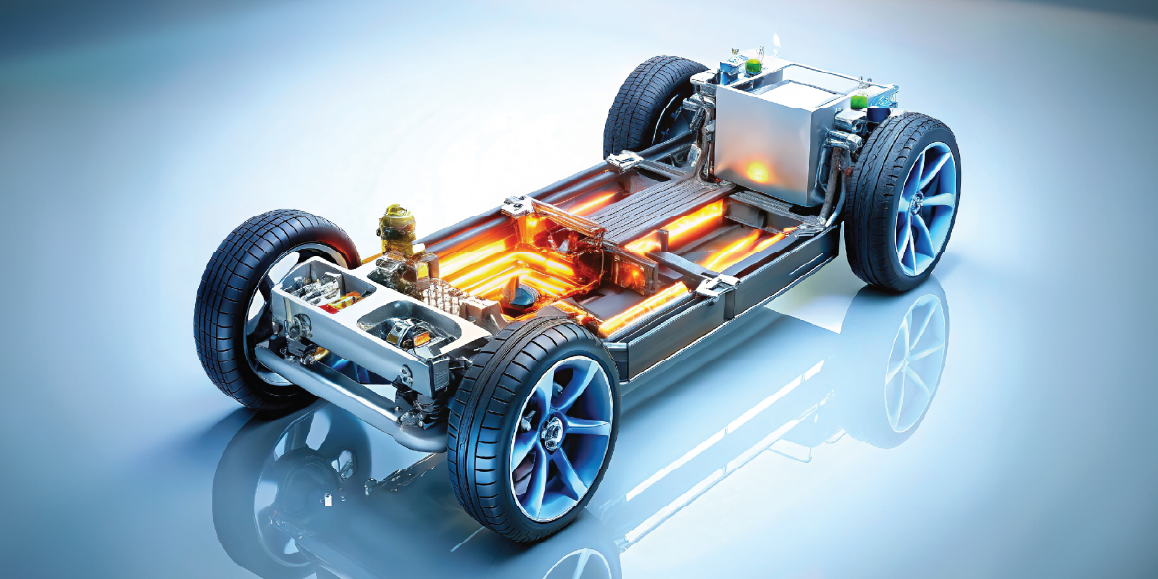
The electric vehicle (EV) industry is witnessing intense competition from established manufacturers to new startups, all striving to capture the market by offering superior products. The race to dominate the EV sector demands shorter product development cycles, compelling manufacturers to design best-in-class powertrains with maximum efficiency, reduced costs, and lower weight. However, designing and optimizing EV powertrains presents several challenges from the view of energy management and thermal regulation to real-world performance validation.
A more efficient powertrain directly translates to extended vehicle range, a key factor influencing consumer adoption. However, one of the biggest challenges in EV adoption is charging speed, as it is nowhere near as quick and convenient as refuelling an internal combustion engine vehicle. Reducing charging time and improving vehicle efficiency are critical hurdles that the automotive industry is actively addressing through research and development.
Since the early days of automotive engineering, design engineers have had a clear understanding of the necessary battery capacity, powertrain components, and other specifications required for developing a vehicle. However, ensuring that these individually selected components work together as an optimized system remains a challenge. A set of individually optimized components does not necessarily equate to an optimized powertrain. The true potential of an EV powertrain lies in how well its components—battery, motor, inverter, and transmission—work together as an integrated system.
This blog explores key challenges in EV powertrain technology and how Ansys ConceptEV empowers manufacturers to overcome these obstacles effectively.
Ansys ConceptEV is a specialized cloud-based design and simulation platform for the early-stage development of electric powertrains from a system-level perspective. It provides a collaborative environment where design teams can fine-tune the interactions between different powertrain components, ensuring maximum efficiency and performance.
ConceptEV ensures seamless integration between powertrain components and acts as a simulation-driven evaluation platform, providing insights into how effectively a powertrain performs with the given components enabling accurate data exchange. It processes inputs for the battery, inverter, motor, and transmission, analyzing their interactions and dependencies.
The battery’s state of charge (SOC), thermal behaviour, and voltage output influence the inverter’s efficiency and motor performance. The inverter’s switching losses and thermal characteristics affect motor torque and speed, while the motor’s torque-speed characteristics depend on inverter control and battery output. Transmission gear ratios impact motor loading and overall energy consumption. By continuously evaluating these interdependencies, ConceptEV enables engineers to assess different configurations, understand trade-offs, and make informed decisions to refine the powertrain for improved efficiency and performance.
Despite significant advancements in EV technology, manufacturers continue to face several challenges in achieving optimal performance, efficiency, and cost-effectiveness. Below are some of the key hurdles and how Ansys ConceptEV helps in overcoming them.
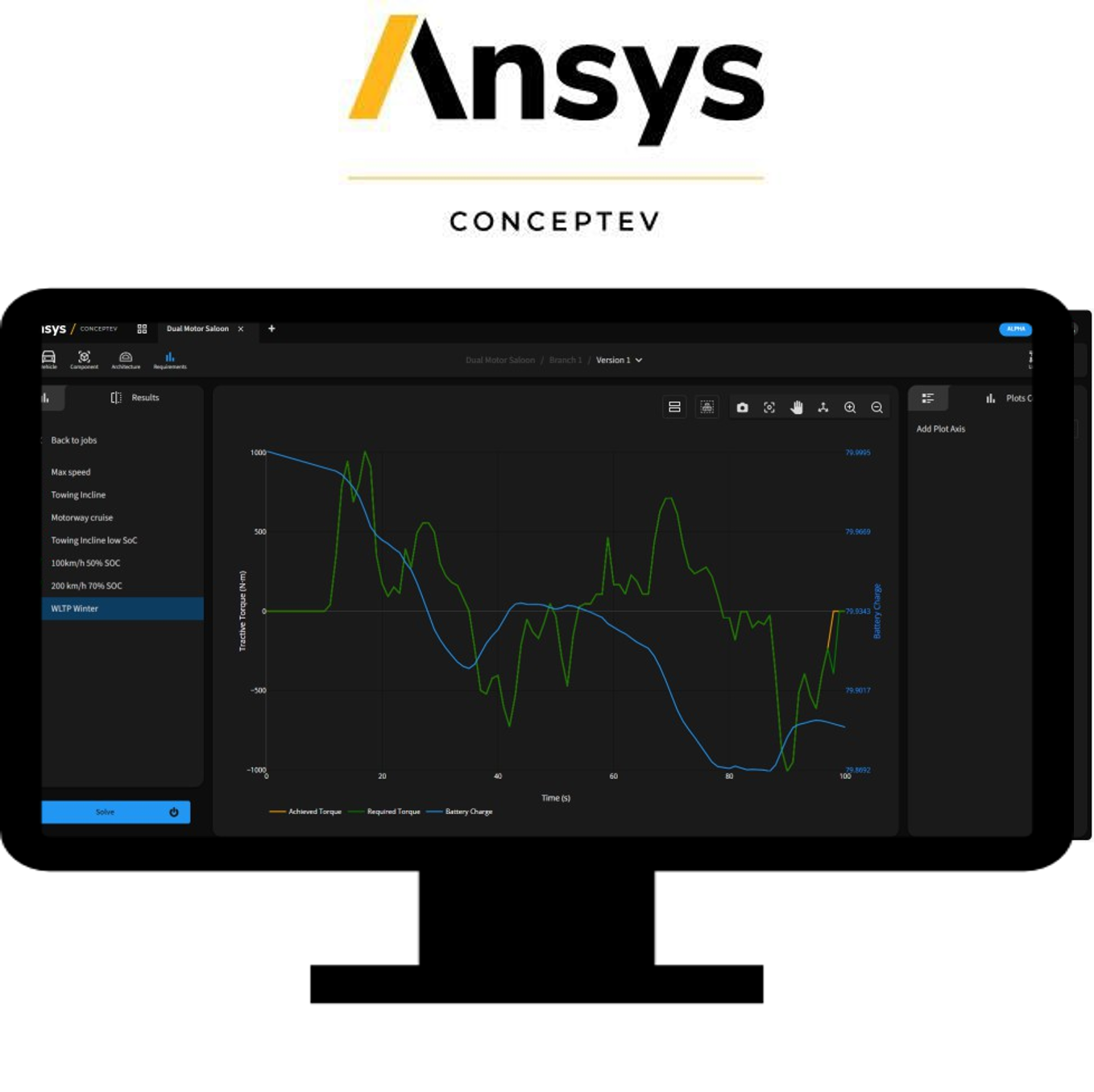
Ansys ConceptEV provides comprehensive solutions for optimizing electric powertrain efficiency, performance, and longevity. Key features include:
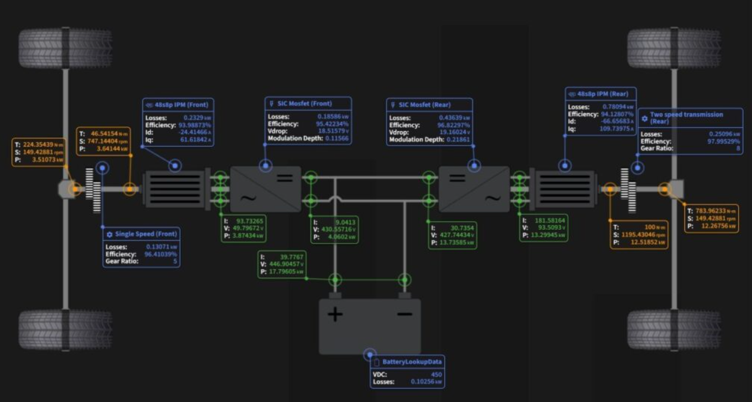
ConceptEV can seamlessly integrate with other Ansys tools to enhance EV powertrain design. It works with Ansys optiSLang for design space exploration, Ansys Motor-CAD for multiphysics motor simulations, and Ansys Maxwell for advanced electromagnetic field analysis. Additionally, ConceptEV supports third-party tool integration and custom workflow automation through its Python API, enabling manufacturers to streamline their development processes.
As the global demand for high-efficiency electric vehicles continues to rise, Ansys ConceptEV is driving innovation in EV powertrain design. By enabling manufacturers to develop optimized electric drive units (EDUs), refine energy management strategies, and enhance system reliability, ConceptEV plays a crucial role in shaping the future of electric mobility.
With its advanced simulation capabilities, seamless tool integration, and AI-powered predictive analysis, ConceptEV empowers automakers to build smarter, more efficient, and future-ready electric vehicles while reducing costs and accelerating time-to-market.
As EV technology evolves, manufacturers that leverage cutting-edge simulation tools like Ansys ConceptEV will lead the charge in creating the next generation of high-performance, sustainable electric vehicles.
 Multi Physics
Read the CADFEM guide to smart BMS functions, automotive thermal management, centralized vs. modular architectures, and Ansys simulation
Read Article → Structures
Di tengah pesatnya perkembangan teknologi rekayasa, adopsi CAE di Indonesia menjadi kunci utama dalam meningkatkan efisiensi dan produktivitas berbagai sektor industri.
Read Article → Electronics
Learn how to use Ansys HFSS SBR+ for 77 GHz automotive radar simulation, evaluating radome effects, antenna performance, radiation patterns, and installation.
Read Article →Connect with CADFEM experts for advanced simulation, automation, and engineering solutions tailored to your industry.