Battery Management System (BMS) Design & Simulation Software

Develop, test and validate safer, smarter battery management systems with simulation

Battery Management Systems (BMS) are the control centre of modern electric vehicle batteries, continuously monitoring and managing charging, energy storage, performance, thermal behaviour, degradation and safety. As battery systems become more complex, engineers need to validate BMS behaviour early—before relying on extensive physical testing.

Ansys provides an integrated approach to BMS development, system-level simulation, functional safety analysis and embedded software development, helping engineering teams improve safety, reduce development effort and make faster, more informed design decisions.

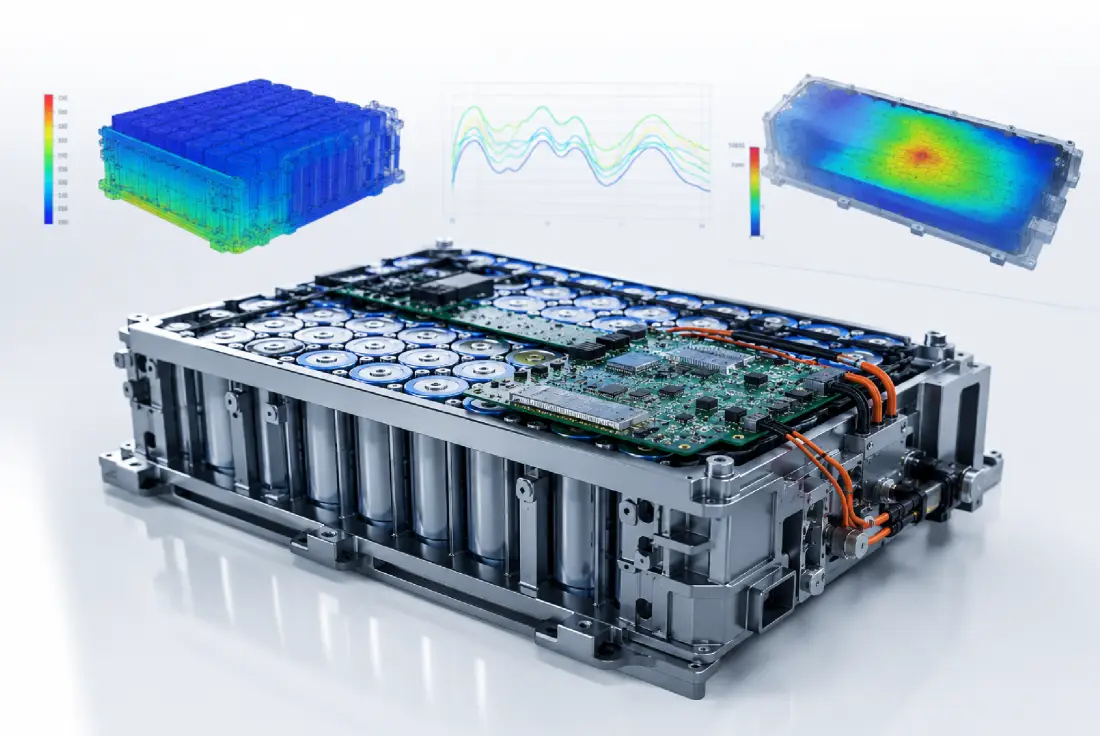
Battery pack with its BMS control board, shown alongside thermal and structural simulation results

Why Simulate Battery Management Systems?

BMS development requires coordination between battery, electronics, controls and embedded software. Traditional approaches that rely heavily on physical prototypes and testing can make it difficult to identify how changes in one domain affect overall system behaviour. Model-based and simulation-driven approaches provide a common environment to explore these interactions earlier in the development process.

Key Benefits

  • Virtual BMS Testing
  • Early Fault Detection
  • Reduced Physical Testing
  • Faster Validation
  • Improved Safety
  • System-Level Insights

An Integrated Approach to BMS Development

Ansys combines physics-based simulation, model-based development, safety analysis and embedded software solutions to support BMS development from system architecture through software verification and virtual validation.

Functional Safety

Analyze BMS architectures, identify potential hazards and evaluate failure modes to support the development of safe and compliant battery systems.

Capabilities

  • HARA
  • FMEA
  • FTA
  • ASIL Assessment
  • ISO 26262
  • Traceability

Ansys solutions support safety-integrated BMS development, including ISO 26262-qualified code generation up to ASIL D.

System-Level Simulation

Simulate the interaction between the battery, BMS and vehicle system to understand performance across operating conditions and battery life.

Capabilities

  • Battery Simulation
  • BMS Integration
  • Thermal Management
  • Lifecycle Analysis
  • Virtual Testing
  • Reduced-Order Models

Embedded Software Development

Develop, simulate and verify the software that controls critical BMS functions before deployment to the vehicle.

Capabilities

  • Model-Based Development
  • Software Simulation
  • Code Generation
  • Software Verification
  • Safety-Critical Software

Model-based approaches also help battery and software teams understand the effects of design changes and trade-offs across mechanical, electrical and software domains.

BMS Development Workflow

From System Architecture to Virtual Validation

  1. 01

    System Architecture

    Define battery, BMS and vehicle-level architecture.

  2. 02

    Safety Analysis

    Identify hazards, risks and failure modes.

  3. 03

    Software Development

    Develop and verify BMS control software.

  4. 04

    System Simulation

    Simulate battery and BMS interactions.

  5. 05

    Virtual Testing

    Test normal and fault operating conditions.

  6. 06

    System Validation

    Verify performance, safety and software behavior.

Simulate Critical BMS Functions

A modern BMS must manage several critical battery functions. Ansys solutions can support the development and verification of algorithms and software associated with:

  • Cell Balancing
  • Thermal Management
  • SoC Estimation
  • Voltage Monitoring
  • Current Monitoring
  • Safety Functions
  • Fault Detection

Connecting BMS Development with Battery Simulation

BMS performance cannot be evaluated in isolation. Its behavior depends on the physical battery and the conditions in which the battery operates.

Ansys enables engineering teams to connect battery physics, thermal behavior, structural performance and BMS/software models, helping teams evaluate system-level interactions and make informed design decisions earlier.

This can include analysis of

  • Battery Electrochemistry
  • Thermal Runaway
  • Thermal Management
  • Mechanical Performance
  • Battery Degradation
  • BMS Control

Featured Ansys Solutions for BMS

Functional Safety & Risk Analysis

Ansys medini analyze

Perform integrated safety analysis to support the development of safe and reliable BMS architectures.

Key capabilities

  • Safety Analysis
  • FMEA / FTA
  • HARA
  • ASIL Assessment
  • ISO 26262
  • Traceability
View Product

Embedded BMS Software Development

Ansys SCADE Suite

Develop and verify safety-critical embedded software using model-based development and qualified code generation.

Key capabilities

  • Model-Based Development
  • Software Verification
  • Simulation
  • Code Generation
  • Certification Support
View Product

System Simulation & Digital Twins

Ansys Twin Builder

Create system models and digital twins to simulate battery and BMS behavior and support virtual validation across the system lifecycle.

Key capabilities

  • System Modeling
  • Digital Twins
  • Virtual Prototyping
  • Reduced-Order Models
  • Lifecycle Simulation
View Product

Why CADFEM for BMS Engineering?

CADFEM combines Ansys simulation technology with engineering expertise to help organizations address BMS challenges across battery simulation, system integration, functional safety and embedded software development.

From battery physics to BMS software, simulation helps engineering teams explore design options, reduce physical testing and make faster decisions throughout the battery development process.

Talk to Our BMS Experts

FAQs

What is a Battery Management System (BMS)?

A BMS monitors and manages battery charging, energy storage, performance, thermal behavior, degradation and safety.

What is BMS simulation?

BMS simulation uses virtual battery, system and software models to evaluate BMS behavior before physical testing.

Why is BMS simulation important?

It helps engineers identify issues earlier, reduce physical testing and validate battery and software behavior across operating conditions.

How does Ansys support BMS development?

Ansys supports BMS development through system simulation, functional safety analysis, model-based software development, code generation and virtual validation.

What BMS functions can be simulated?

BMS simulation can support functions such as cell balancing, thermal management, SoC estimation, voltage/current monitoring and safety functions.

Does Ansys support ISO 26262 for BMS development?

Ansys solutions support safety-related BMS development workflows aligned with ISO 26262, including qualified code generation up to ASIL D.

Contact Us Today