Radiated · Conducted · Immunity · Near-field · BCI
Comprehensive electromagnetic compatibility analysis covering radiated and conducted emissions, radiated and conducted immunity testing, near-field source identification, and bulk current injection simulation for PCB and system level compliance.
Overview
EMC chamber failures late in the development cycle are among the most expensive compliance issues to resolve — requiring hardware spins, re-testing cycles, and delayed market entry. Our EMC simulation team identifies emission sources, susceptibility paths, and coupling mechanisms in the design phase, when corrections are rapid and inexpensive.
We cover radiated and conducted emissions, immunity testing, near-field source mapping, and BCI simulation — providing actionable pre-compliance reports mapped directly to CISPR, IEC 61000, ISO 11452, and automotive EMC standards.
6 Analysis Types
Select a capability to explore the methodology, deliverables, and tools in detail.
FCC · CISPR · far-field emission compliance
Evaluating electromagnetic radiation emitted from electronic devices, ensuring compliance with regulatory emission standards such as FCC or CISPR. Our task involves evaluating electromagnetic radiation emitted from electronic devices, ensuring compliance with regulatory emission standards. Through meticulous testing and analysis, we verify that the electromagnetic radiation emitted remains within acceptable limits, minimizing interference risks.
Computing far-field radiated emission profiles from PCB and system models, comparing predicted emissions against CISPR 22/32, FCC Part 15, and automotive CISPR 25 limits.
Tracing dominant emission sources to specific PCB structures — switching regulators, clock lines, high-speed interfaces — quantifying each contributor's share of the total radiated emission budget.
Providing a structured pre-compliance risk report identifying emission peaks most likely to fail chamber testing and prioritising corrective actions by impact and implementation effort.
power lines · signal lines · conducted limits
Assessing electromagnetic noise conducted through power and signal lines to ensure compliance with conducted emission limits. Through meticulous testing and analysis, we verify that the electromagnetic noise levels transmitted through these lines remain within acceptable thresholds. This process involves setting up controlled test environments, executing comprehensive assessments, and providing guidance to mitigate any identified issues.
Modelling conducted emission measurement setups including LISN impedance, referencing simulated results to the standardised CISPR measurement methodology for direct limit comparison.
Separating conducted noise into common mode and differential mode components to determine the appropriate filter topology — X-capacitors, Y-capacitors, common mode chokes — for each noise mechanism.
Designing and optimising EMI input filters for switching power supplies and motor drives — selecting component values, insertion loss targets, and filter topology to achieve CISPR compliance.
RF immunity · susceptibility · IEC 61000
Testing electronic devices' susceptibility to electromagnetic radiation from external sources, such as RF transmitters or electromagnetic fields. Through rigorous evaluation, we assess the devices' resilience to interference, ensuring their proper functioning in real-world environments. By analysing the devices' responses, we identify potential vulnerabilities and recommend design modifications or shielding techniques to enhance immunity.
Computing induced voltages on PCB traces and cable harnesses from external radiated fields per IEC 61000-4-3 and ISO 11452-2, identifying sensitive circuit nodes at risk of upset.
Identifying circuit regions and interface lines most susceptible to radiated upset, enabling targeted hardening through shielding, filtering, or layout changes before physical testing.
Documenting susceptibility margin above required test levels for each disturbance type, identifying circuits with marginal immunity and recommending targeted hardening measures.
conducted disturbances · noise immunity · IEC 61000-4
Examining devices' susceptibility to conducted disturbances induced through power and signal lines, ensuring reliable operation in noisy environments. Through meticulous testing, we assess the devices' resilience against interference propagated through power and signal lines. We identify potential weaknesses and recommend measures to mitigate susceptibility, such as shielding or filtering techniques.
Simulating conducted disturbances injected through power and signal lines per IEC 61000-4-4, IEC 61000-4-5, and IEC 61000-4-6 to predict device response under standardised test conditions.
Evaluating the effectiveness of input filters, TVS diodes, ferrite beads, and transient protection devices in reducing conducted disturbance levels reaching sensitive circuit nodes.
Quantifying device immunity margins relative to required conducted immunity test levels, identifying components or traces at risk of malfunction and recommending design improvements.
EM coupling · field mapping · source identification
Studying electromagnetic fields close to the source to identify potential sources of interference and assess electromagnetic coupling mechanisms. Through detailed analysis and measurement, we examine the electromagnetic fields emitted by various electronic devices to understand their behaviour and potential impact on nearby systems, recommending effective mitigation strategies.
Scanning and computing near-field electromagnetic distributions above PCBs and electronic assemblies, identifying dominant emission sources and coupling hotspots at component and trace level.
Analysing inductive and capacitive coupling between PCB structures, cable assemblies, and nearby metallic objects — quantifying coupling strength and identifying coupling paths driving EMC failures.
Performing near-field to far-field transformation from board-level field scans or simulation data, enabling correlation with physical chamber measurements and predicting radiated emission signatures.
bulk current injection · EMI susceptibility · ISO 11452
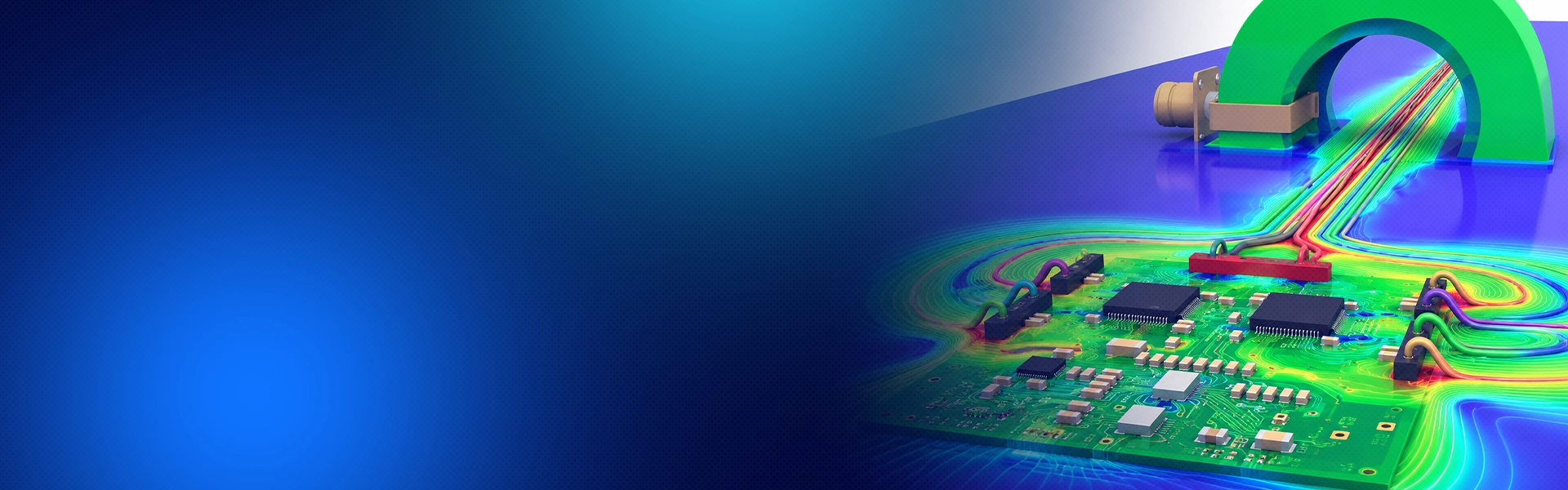
Testing for bulk current injection (BCI) is a crucial method employed to assess the susceptibility of electronic devices to conducted electromagnetic interference (EMI). This rigorous evaluation involves injecting high levels of current directly into the device's power and signal lines to simulate real-world EMI scenarios, identifying weaknesses and recommending mitigation measures such as shielding or filtering.
Simulating ISO 11452-4 BCI test setups including the injection probe, monitoring probe, and device under test (DUT) — replicating the standardised test environment for accurate susceptibility prediction.
Predicting induced voltage and current levels at IC inputs and sensitive nodes from cable injection, validating the adequacy of filter and ferrite protection at target BCI test levels.
Evaluating the effectiveness of cable shields, common mode chokes, and line filters in reducing BCI-induced disturbance levels, optimising protection measures for ISO 11452-4 compliance.
Talk to our Centre of Excellence team about radiated emissions, conducted noise, immunity analysis, near-field diagnostics, or BCI simulation for your product development programme.