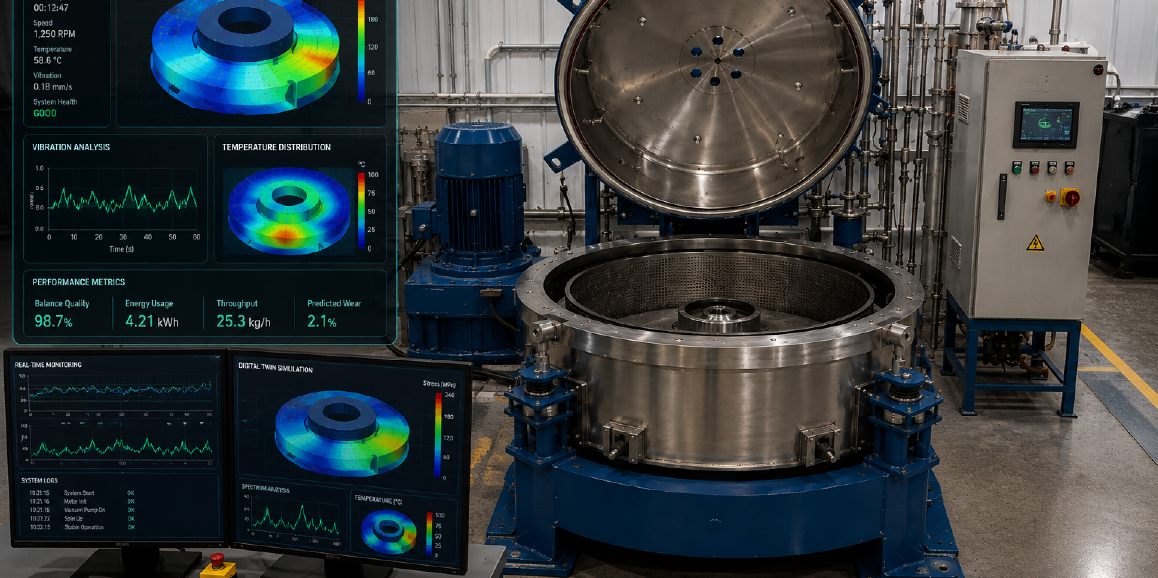
Centrifuge machines are widely used in industrial and laboratory applications to separate materials based on their density. During operation, these machines rotate at extremely high speeds, generating significant centrifugal forces. These forces act radially outward from the axis of rotation and induce stresses throughout the rotating components. Evaluating these stresses is critical for ensuring the structural integrity, safety, and performance of the system.
To analyse such stresses without explicitly simulating rotation, rotational velocity can be applied within a Static Structural analysis framework in Ansys Mechanical. In this approach, the part itself does not physically rotate; instead, rotational effects are represented as inertial body loads within the rotating reference frame formulation.
Section 01Why Static Structural Analysis?
The primary aim of this study is to evaluate stress in a component rotating at a constant angular velocity. Since the rotation is steady (no change in speed), transient effects such as acceleration and damping are not significant. Including them would unnecessarily complicate the analysis, requiring additional unknowns to be solved.
Static analysis offers a simplified yet effective solution in such cases:
- Avoids the computational complexity of transient analysis
- Accurately captures stress distribution due to steady rotational effects
- Particularly useful for quick, reliable stress estimates during design and validation stages
In this formulation, gravity, rotational velocity, and rotational acceleration are treated as inertial loads and included in the force term F(x) of the governing equation.
Section 02Theoretical Background
The centrifugal force on a particle moving with a velocity on a curve is given by:
F = ρ · ω² · r
Where: ρ = density (ton/mm³), ω = rotational speed (rad/s), r = radius (mm)
An important observation is that the centrifugal body force density increases linearly with radial distance from the axis of rotation. Therefore, elements located farther from the centre experience higher forces.
For a solid homogeneous circular disk of uniform thickness, the radial stress at any point at distance r from the centre is (Roark's Formula, 7th Ed., Page 746):
σᵣ = ρ · ω² · (R² − r²) / 8 · (3 + μ)
Key physical insight on stress distribution
Although the outer edge experiences the highest centrifugal force, it is free to deform outward and therefore carries zero radial stress. In contrast, the centre must resist the cumulative outward pull of all surrounding material — resulting in maximum stress at the centre.
Section 03Boundary Conditions & FEA Setup
To simulate the system in Ansys Mechanical:
- A cylindrical support is applied at the shaft/motor interface to restrict motion appropriately.
- Rotational velocity is applied to the rotating disk as an inertial load.
- The outer diameter is kept free to deform naturally.
Key points to remember:
- The outer boundary must remain unconstrained to correctly represent real physical behaviour.
- Radial stresses should be extracted using a cylindrical coordinate system to ensure proper directional interpretation.
Section 04Results & Validation
Theoretical verification at the outer edge (r = R = 203 mm): σᵣ = 0 MPa — confirming that radial stress is zero at the outer boundary.
At r = 12.5 mm (inner region), with R = 203 mm, μ = 0.25, ρ = 7.95×10⁻⁹ ton/mm³, ω = 209.44 rad/s: the theoretical radial stress = 5.82 MPa.
5.82 MPa
theoretical radial stress (centre)
6.0 MPa
Ansys FEA result (centre)
0 MPa
radial stress at outer edge
The FEA results show slightly higher stress values than the analytical calculation. This deviation is expected due to the influence of boundary conditions, geometric constraints, and numerical approximations within the simulation.
Section 05Modal Analysis for Resonance Risk Assessment
A pre-stressed modal analysis is linked from the static structural result to identify natural frequencies under the centrifugal loading state. The critical operating frequency is:
f₁ = ω / 2π = 209.44 / 2π = 33.33 Hz
Natural frequencies within ±10% of operating harmonics should be investigated for potential resonance risk:
- 1× (33.33 Hz) — Risk zone: 29.99–36.66 Hz
- 2× (66.66 Hz) — Risk zone: 59.99–73.33 Hz
- 3× (99.99 Hz) — Risk zone: 89.99–109.99 Hz
Conclusion
Static structural analysis is an efficient and practical method for evaluating stresses in rotating components operating at constant angular velocity. By neglecting transient effects such as acceleration and damping, the governing equations are simplified, making the analysis more computationally efficient while still providing accurate stress predictions.
In this method, the component does not physically rotate; instead, the coordinate system rotates, allowing centrifugal effects to be modelled as inertial loads. When combined with modal analysis, this approach also enables identification of critical frequencies and potential resonance risks.
Static analysis serves as a powerful tool for preliminary design and validation of rotating systems, ensuring structural integrity without the need for complex transient simulations.
— Wakar Ali Mohammad Khan, CADFEM Mechanical Business Unit
Found this useful? Share it WK
Written by
Wakar Ali Mohammad Khan
Wakar Ali Mohammad Khan specialises in structural analysis of rotating machinery using Ansys Mechanical, with expertise in centrifugal stress evaluation, modal analysis, and theoretical validation.