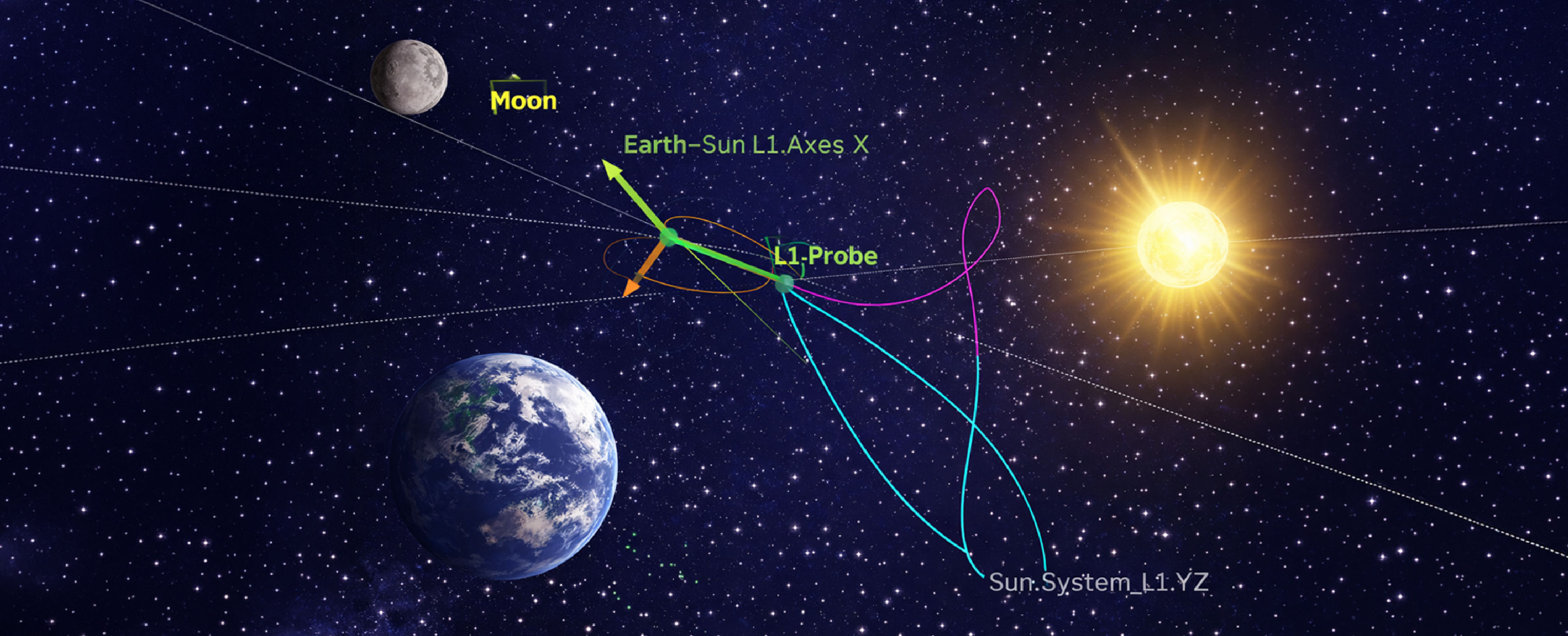
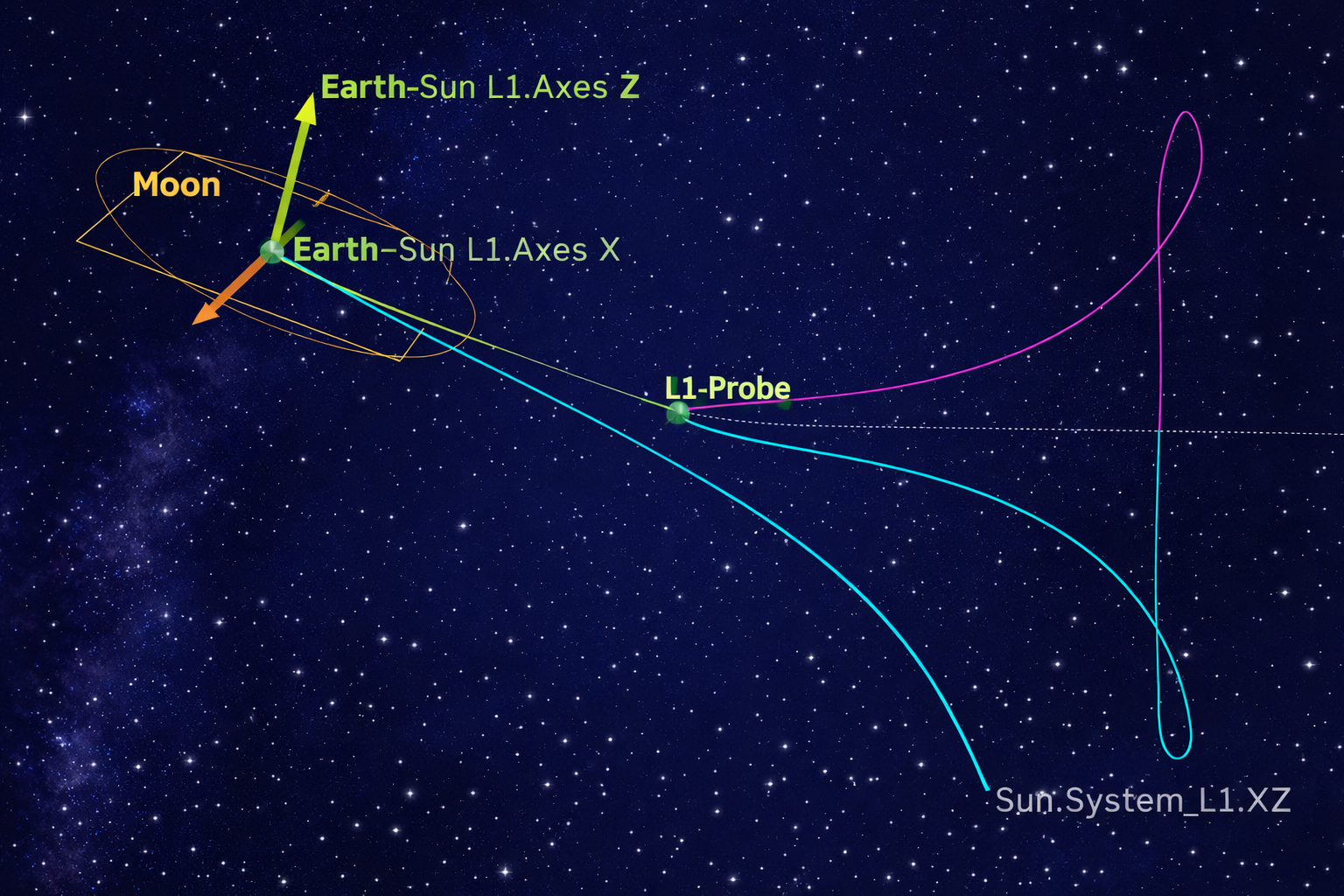
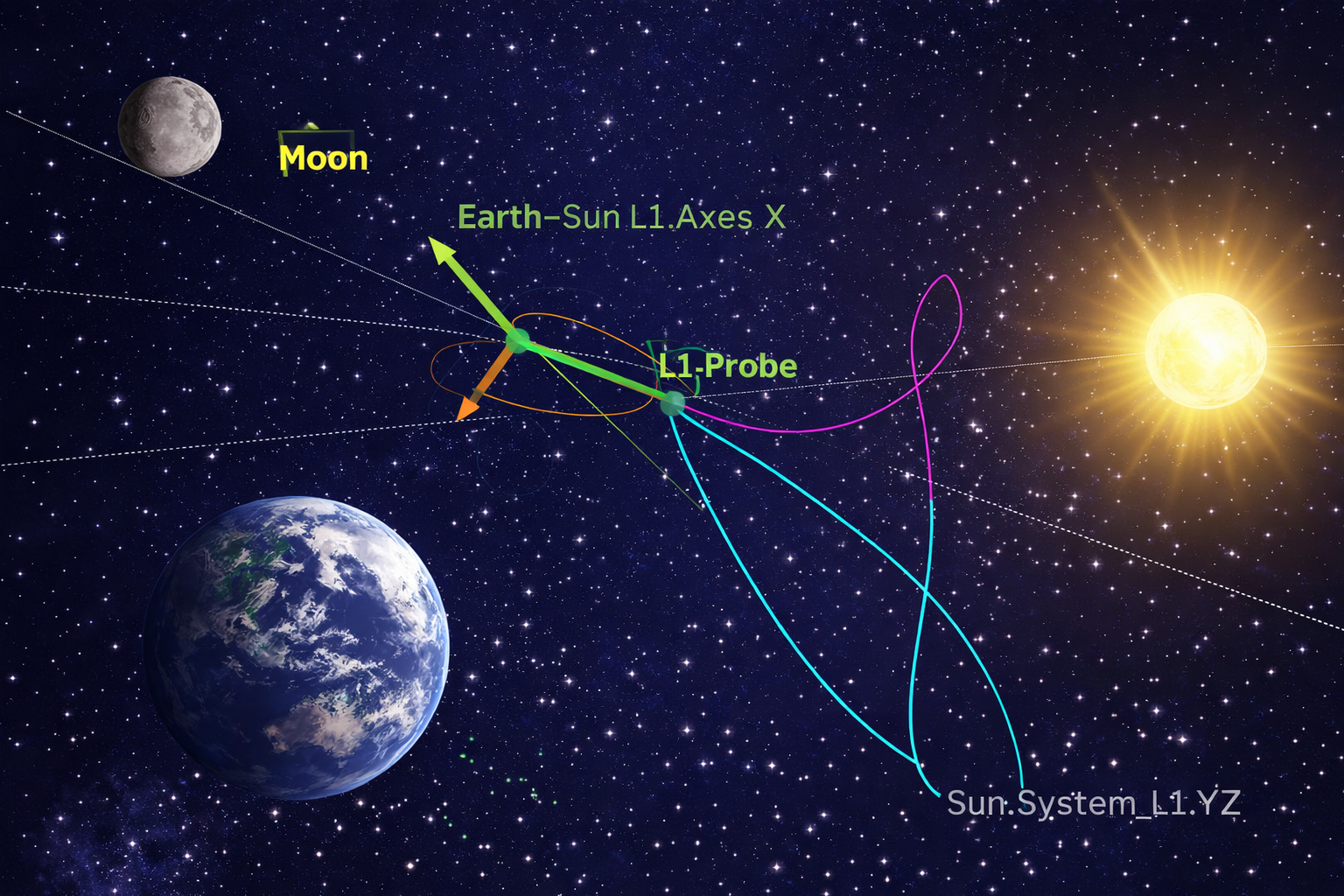
Space mission planning was an ordeal that once took many days of mathematical analysis and manual plotting. Today, advanced software such as Ansys STK — especially its Astrogator module — lets analysts watch the mechanics take place right in front of them. This article walks through how a spacecraft flight to the Sun–Earth L1 Lagrange point can be simulated, end-to-end.
Section 01The significance of Sun–Earth L1
About 1.5 million kilometres away from Earth in the direction of the Sun is L1 — a point where gravitational forces and orbital motion balance, holding a spacecraft in a stable position relative to both bodies.
A satellite stationed at L1 would have a clear, unobstructed view of the Sun's surface, which makes it ideal as a solar observatory or a spacecraft that monitors space weather — SOHO and DSCOVR being the classic examples.
However, maintaining a position at L1 is not easy. Even a small change in velocity can make the spacecraft drift away from its position; L1 is dynamically unstable.
Section 02Building the mission in STK — a digital launchpad
Before there is any mention of propulsion burns, there are simulations. STK provides a virtual sandbox where all mission aspects can be tested — from orbital mechanics to communication geometry — without leaving your desk.
A typical L1 mission concept development looks like this:
- Set up your scenario — define your timeframe (e.g. January 2025 to mid-2026). The timeframe determines the scope of your virtual world.
- Include celestial bodies in the simulation — the Sun, Earth and Moon are added to make the simulation realistic. STK's ephemeris handles all positions automatically.
- Set up your visualization — 2D or 3D view, Earth-centric, heliocentric, or whatever suits the analysis.
From this moment onwards, your simulation starts to resemble reality.
Section 03The journey from Earth to L1
A spacecraft leaving LEO must perform a precise procedure to escape Earth's gravitational field and arrive at L1. In STK Astrogator, the process is represented graphically:
- Plan the mission — specify LEO propagation, injection burn and coasting toward L1.
- Establish target parameters — distance is not enough; the point of convergence must coincide with Earth's motion around the Sun.
- Present the trajectory — several iterations are typically needed to establish the right injection window.
Unlike stationary orbits, Lagrange-point transitions are very delicate and sensitive to initial parameters. Even minor variations in launch time can result in a completely different trajectory — a textbook example of nonlinear orbital mechanics.
Section 04Refining the L1 orbit — controlled instability
L1 is merely the beginning. The location itself acts as an unstable equilibrium, comparable to balancing a ball on a mountain peak. Left unchecked, the satellite will drift off course — either back toward Earth or out into space.
To maintain a stationary position relative to L1, a halo or Lissajous orbit model needs to be constructed. In STK, this entails:
- Tweaking velocity and phase angle at the Sun–Earth plane crossing.
- Applying targeting profiles to satisfy position and velocity requirements.
- Small perturbation iterations to reach a stable orbit pattern.
Each iteration in Astrogator amounts to a computational experiment of orbital mechanics.
Section 05Sustaining the mission — station-keeping dynamics
Once operational, the spacecraft conducts periodic adjustments every few weeks or months to counteract perturbing forces — Moon gravity, solar radiation pressure and the inherent instability of the L1 zone.
With Astrogator you can:
- Set up automated burns driven by event-based conditions (such as plane crossing).
- Assess fuel economy and ΔV requirements.
- Graphically see how each adjustment keeps the spacecraft inside the L1 "bubble."
For long-range mission planning, these manoeuvres are what determine whether the project is a one-year test run or a ten-year operation.
Amidst all the numerical instability of the Sun–Earth transit route, there exists one of the most stable concepts in engineering today — the concept of simulation.
— Abhishek Jain, CADFEM Digital Mission Engineering
Section 06From simulation to insight
It is not simply the fact that STK can plot trajectories — but the insights generated from them:
- Manoeuvre profiles identify burns that require the greatest ΔV.
- Fuel models determine whether the propellant budget will last through the mission duration.
- Custom reports and plots directly relate orbital characteristics to mission operations such as communication and lighting.
This gives a full understanding of the spacecraft's behaviour, longevity and communications capabilities — even before it leaves the ground.
1.5M km
Earth to L1 distance
ΔV
budget tracked per burn
Conclusion — engineering in the space between worlds
A mission design for Sun–Earth L1 is an example of the elegance of orbital dynamics: gravitational equilibrium, precise navigation, and human innovation.
The use of modern software such as STK Astrogator does not detract from physics — rather, it enhances it by translating formulas into three-dimensional models where mission designers can play, visualize and tweak their designs long before any propulsion systems are ignited.
Found this useful? Share it