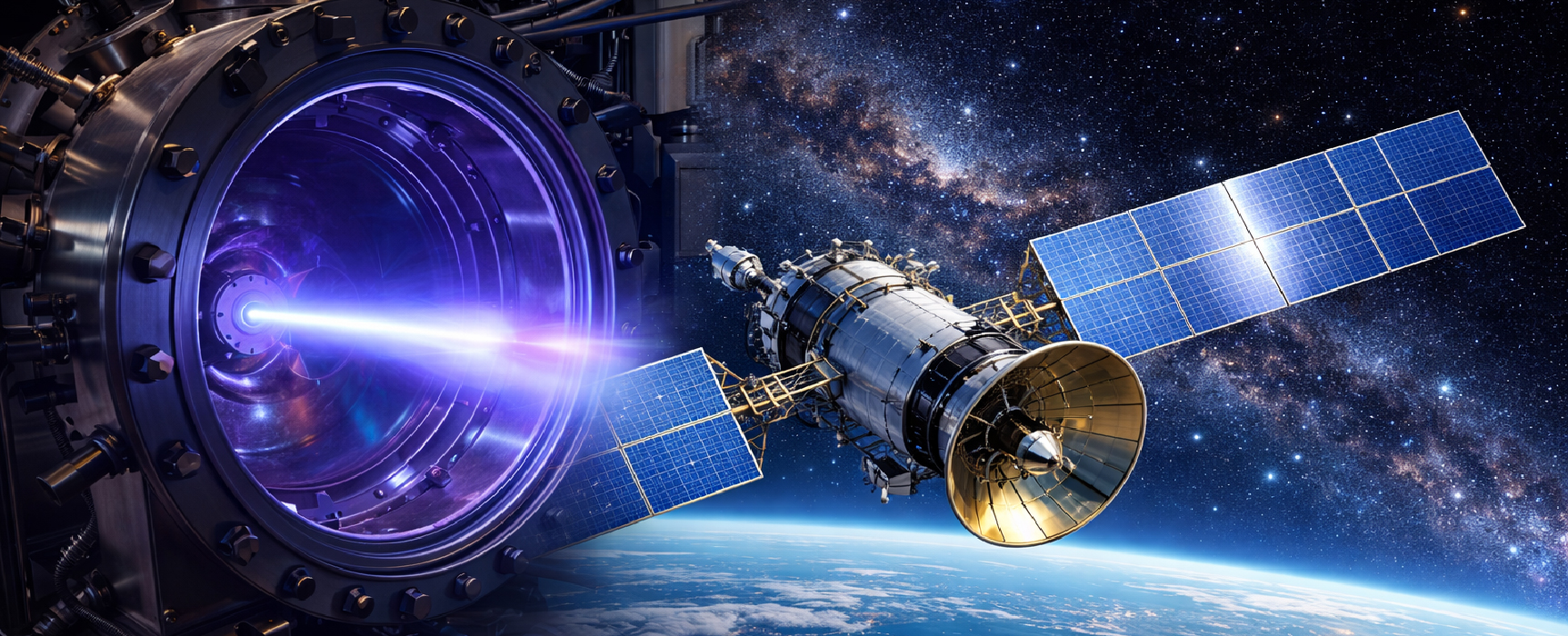
Plasma, often called the fourth state of matter, is estimated to make up about 99% of the visible universe. It is a collection of positively charged ions, negatively charged electrons, and neutral particles that exhibit collective behaviour and form an overall electrically neutral system. The ionosphere, lightning, and fire are the classic natural plasma phenomena on Earth — and in industry, plasmas are critical to semiconductor processes such as PECVD and etching.
The primary challenge in plasma-based manufacturing is achieving process repeatability and uniformity at nanoscale dimensions. That challenge is addressed by measuring key plasma parameters, and plasma diagnostic tools play a central role in enabling accurate parameter measurement.
What this article covers
A complete simulation workflow for a cylindrical Langmuir probe in Ansys Charge Plus — from geometry setup and boundary conditions to a voltage-ramp polarity study that reveals classic probe–plasma behaviour.
Section 01Langmuir Probe as a Plasma Diagnostic Instrument
While many plasma diagnostic tools exist — including emissive probes, magnetic probes, plasma spectroscopy, mass spectrometry, Thomson scattering and X-ray framing cameras — Langmuir Probes (LPs) remain the focus, thanks to their direct, quantitative measurement of electron density, temperature and plasma potential across space, laboratory and industrial plasmas.
LPs are commonly designed in spherical and cylindrical shapes. Cylindrical probes are generally preferred for laboratory chamber plasmas and are widely used in GEC (Gaseous Electronics Conference) reference cells — the standardized RF plasma chambers used for reproducible plasma processing research. LPs are also employed in inductively coupled (ICP) and capacitively coupled (CCP) plasmas, and in plasma-based sputtering, etching and deposition processes.
Spherical LPs, by contrast, are commonly used for space measurements and integrated into satellites — Rosetta's two LAP probes and Cassini's Langmuir probe being the classic examples. Spherical LPs enable isotropic collection from all directions; cylindrical LPs, with lengths much greater than their radii, collect predominantly radially.
Section 02Working Principle of a Langmuir Probe
The probe is connected to an external circuit where a precisely controllable bias voltage is applied relative to the grounded plasma chamber. By varying this bias voltage, the potential of the probe is altered relative to the surrounding plasma — selectively attracting or repelling charged species:
- Negative bias — repels electrons, attracts positively charged ions.
- Positive bias — attracts electrons, repels positive ions.
The probe current is determined indirectly by monitoring the voltage drop across a known series resistor and applying Ohm's law. Sweeping the probe bias over a range of negative and positive values and recording the current at each step produces a complete current–voltage (I–V) characteristic — from which electron temperature, electron density, ion saturation current and plasma potential are extracted.
Real experiments can be complex, costly, time-consuming and sometimes risky. Simulation helps engineers understand, predict and optimize plasma behaviour without always having to test it physically. Three classes of simulators are commonly used in plasma diagnostics:
- Electromagnetic (EM) simulators — solve Maxwell's equations to model the electric and magnetic fields within the plasma.
- Circuit simulators — solve the differential equations of the connected circuits using Kirchhoff's laws.
- Behavioural / reduced-order — use tables, transfer functions or equivalent circuits to approximate response quickly for system-level studies.
Ansys Charge Plus stands out for plasma simulations because it solves Maxwell's equations directly. It integrates electromagnetic, particle, fluid and chemical-reaction models into a single interface, and engineers can use GPU acceleration to drive rapid design iterations. In this article we use Ansys Charge Plus to set up and run the Langmuir probe simulation.
Section 04Pre-processing and material assignment
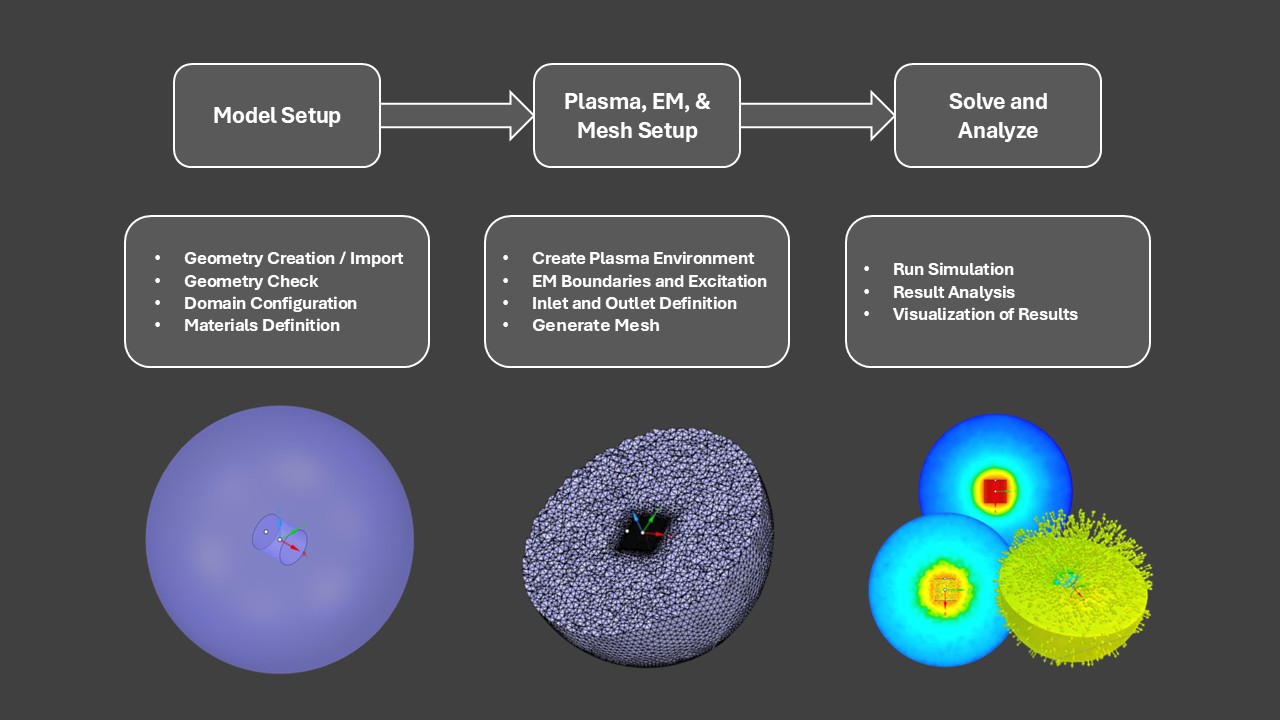
Ansys Charge Plus is embedded within Ansys Discovery, which supports a wide range of CAD import formats such as STEP and STL. Discovery provides intuitive geometry-editing tools for cleaning, repairing and preparing CAD models before simulation.
For this study, the probe geometry is created using Discovery's design tab: the Langmuir probe is modelled as a cylindrical body, while the surrounding plasma region is represented by a sphere enclosing the probe. Once the geometry is defined, the solver is configured in the Charge tab by selecting Plasma Dynamics, defining appropriate time-stepping, and enabling the PIC options to ensure accurate representation of plasma density.
Materials can be assigned either from Ansys Charge Plus's built-in libraries or by creating custom materials with editable dielectric constant, bulk conductivity, atomic mass, atomic number and density. In the present simulation, vacuum is selected from the material library and assigned to the spherical region representing the plasma.
Section 05Plasma environment, boundary conditions and mesh
Ansys Charge Plus supports both predefined plasma environments — Argon (low/high energy), Atmospheric Hydrogen/Nitrogen, GEO Maxwellian, Double Maxwellian — and fully custom plasma definitions. For this study, a custom plasma is defined for the Particle-in-Cell (PIC) analysis using electrons and singly-ionized argon (Ar⁺): a Maxwellian distribution is applied to the electrons, with temperature specified in eV and density in N/m³, while the Ar⁺ ion species is characterized by explicit temperature, density and mass.
Two EM boundary conditions are then defined — one on the outer spherical plasma boundary and one on the cylindrical probe surface. For the probe, a linear ramp signal is created in the Signals section and dragged onto the probe BC to apply the voltage excitation. The environment boundary conditions are:
- Inlet — applied to the outer spherical surface; specifies density and velocity for both electron and Ar⁺ ion PIC species.
- Outlet — applied to the inner cylindrical (probe) geometry with
Loss Fraction = 1, so all incident particles are absorbed. Both plasma species are selected.
- Sheath — not used in this study (it would override the Outlet BC).
Resolution is set and Direct Mesh Groups are used for targeted, high-fidelity meshing of the probe surface.
The Outlet boundary condition with Loss Fraction = 1 is what makes the probe "absorb" charged particles. Reduce it and you start modelling reflections instead of collection.
— Application notes, CADFEM Plasma Practice
Section 06Simulation execution and visualization
Click Start in the Analysis section to export the required files and initiate the run using the parallel processes specified in the Domain settings. Make sure the number of parallel processes does not exceed the available logical processors on the host machine.
Enabling "Generate Charge Results in HDF5 Format" writes all simulation results to a single HDF5 file; disabling it produces DAT files instead. Results appear in the Results section of the simulation tree — right-click and select Internal Graphite Visualization, choose the time steps and click Visualize Results to display them.
Contours visualize results in Discovery Graphite, with variables including PIC Density, PIC Temperature, PIC Momentum Density, PIC Charge, Energy Density, Electric Potential and Electric Field. 2D time plots can also be exported as images. Charge Plus results are compatible with both ParaView and EMA3D Connect, and the standard HDF5 export keeps the data portable.
Section 07Voltage-ramp polarity — what the simulation shows
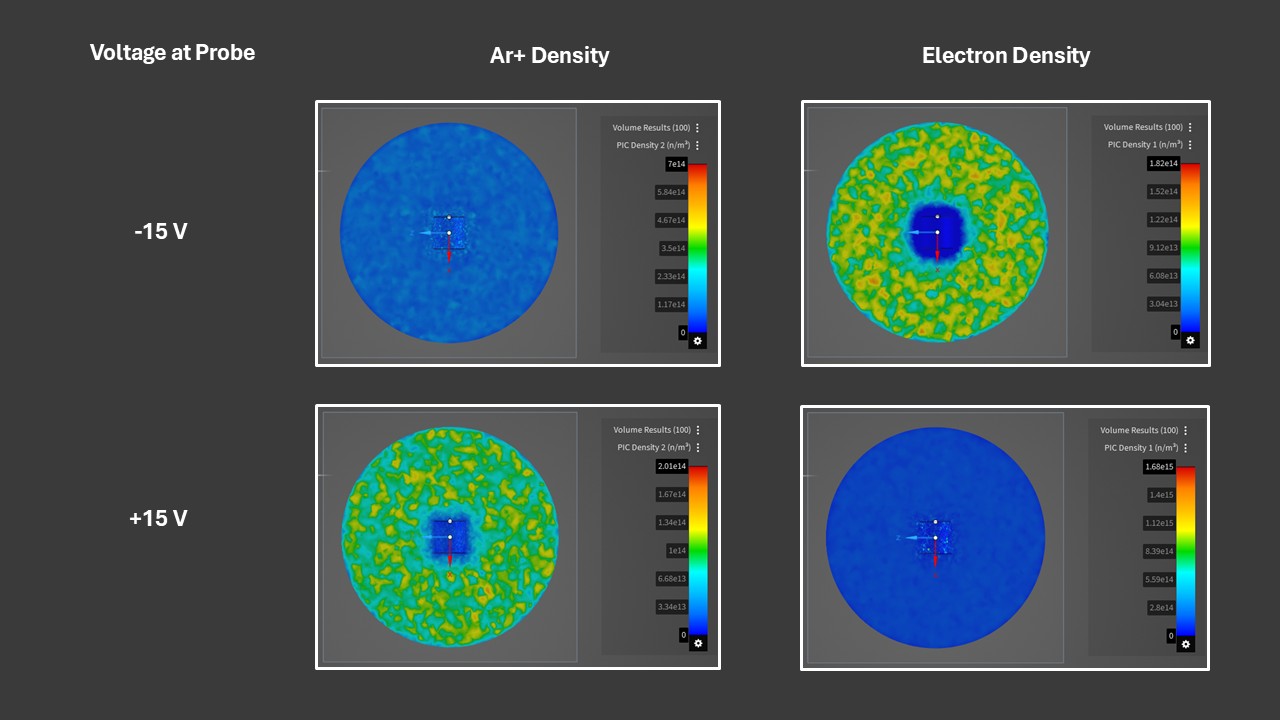
To investigate the underlying physics, the simulation examines two voltage-ramp conditions: one ramping from 0 → +15 V and another from 0 → −15 V.
- Under the 0 → −15 V ramp, the probe is negatively biased — it attracts positive argon ions while repelling electrons.
- Under the 0 → +15 V ramp, the positively biased probe attracts electrons and repels positive ions.
The simulation produces a clean visual signature for each polarity — exactly as classical probe theory predicts, but now with full field data and parameter sweeps available for further analysis.
Conclusion
This study demonstrates how Ansys Charge Plus can simulate a cylindrical Langmuir probe in a Maxwellian plasma environment, capturing field behaviour and probe–plasma interactions through an EM + PIC approach. The voltage-ramp study highlights the expected attraction and repulsion of electrons and ions based on probe bias polarity, and the flexible visualization and post-processing options make this virtual-diagnostic workflow a time-efficient complement to experimental measurements — for both research and industrial plasma applications.
With only minor modifications, GEC or CCP plasma simulations can also be performed in Ansys Charge Plus using the same workflow.
Found this useful? Share it