ANALYSIS TYPE / 07
Assemblies with Large Motions of Complex Systems of Interconnected Bodies
Overview
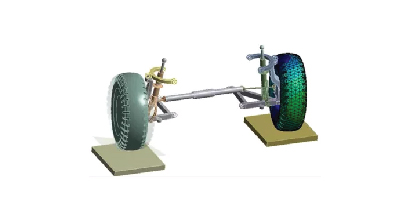
The simulation of large movements of complex systems of interconnected bodies is what multibody dynamics is all about in structural dynamics. Kinematical joints and force elements such as springs, dampers, and actuators connect these bodies, which can be rigid or flexible. Multibody dynamics (MBD) simulates the motion, forces, and interactions of interconnected rigid and flexible bodies in mechanical systems — enabling early prediction of loads, wear, and system-level dynamic behaviour before detailed FEA is performed. It is commonly used in vehicles, spacecraft, robots, mechanisms, and biomechanical systems.
Industries Served
Deliverables
Key Aspects
Computing positions, velocities, and accelerations of all bodies in the mechanism as a function of time or driver input — verifying range of motion and identifying interference.
Computing joint forces and moments under operating loads — providing realistic boundary conditions for subsequent component-level FEA and fatigue analysis.
Replacing rigid bodies with flexible representations (Craig-Bampton modes) to capture the coupled effect of structural compliance on system-level dynamic response.
Generating time-history loading at critical attachment points from MBD under representative drive cycle and road surface inputs — feeding fatigue life predictions.
Connect with our structural simulation team to discuss the right approach for your application.