ANALYSIS TYPE / 02
Vibration Analysis to Predict Dynamic Response
Overview
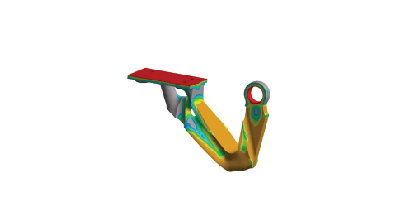
Linear dynamic analysis refers to the process of analyzing the dynamic response of a structure or system under varying loading conditions. This type of analysis involves studying how a structure or system behaves when subjected to dynamic forces such as vibrations, oscillations, or seismic events. The different types include Modal Analysis, Harmonic Response Analysis, Random Vibration Analysis, Eigenvalue Buckling Analysis, and Response Spectrum Analysis. These analyses are essential for understanding resonance, structural integrity under dynamic loads, and compliance with vibration standards across a wide range of industries.
Industries Served
Deliverables
Key Aspects
Computing natural frequencies and mode shapes to understand the fundamental dynamic characteristics of the structure and identify resonance risk with excitation frequencies.
Calculating the steady-state amplitude and phase of structural response to sinusoidal excitation as a function of frequency — used for NVH and vibration compliance.
Evaluating structural response to broadband random excitation defined by a Power Spectral Density — applicable to aerospace, electronics, and automotive durability.
Simulating structural response to time-dependent loading events — impact impulses, step loads, and seismic excitation — using implicit or explicit time integration.
Connect with our structural simulation team to discuss the right approach for your application.