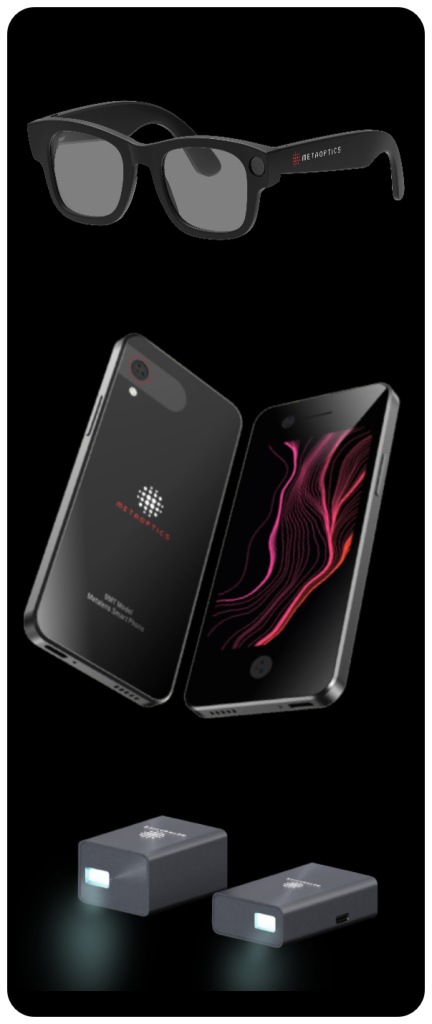
MetaOptics Redefine Consumer Electronics with
Metalens designed using Ansys Optics Solutions
As electronics continue to shrink and increase in complexity, conventional optics remain
limited by traditional glass and plastic manufacturing. MetaOptics was founded to bridge
this gap by combining semiconductor-grade fabrication with advanced optical design,
enabling wafer-level metalens solutions that are ultra-thin, scalable, and production-ready.
Achieving reliable performance at sub-wavelength scales requires physics-accurate
simulation to model light–matter interaction and translate nanoscale behavior into
predictable, system-level optical performance.
From its early stages, MetaOptics recognized the importance of a strong simulation
foundation and engaged with CADFEM SEA for initial consultation on simulation software
strategy and supporting hardware requirements, ensuring a scalable and future-ready
engineering environment.
Company Description
MetaOptics is a technology company focused on advancing metalens innovation through
a combination of precision optical design and scalable manufacturing. By developing its
own manufacturing, testing, and assembly capabilities, MetaOptics enables reliable
integration of metalens solutions across consumer electronics, sensing, and imaging
applications. Driven by continuous innovation and engineering excellence, the company
aims to establish itself as a global leader and center of excellence in metalens
technology.
Business Challenges
MetaOptics’ goal was not to demonstrate laboratory
concepts, but to deliver metalens-based products that
could be manufactured reliably at scale.
Designing ultra-thin metalenses capable of high image quality across RGB wavelengths and wide fields of view, while controlling chromatic aberrations and off-axis distortions.
Nanoscale variations in fabrication—such as lithography deviations, misalignment, and material changes—could significantly impact optical performance if not addressed early.
Translating electromagnetic behavior at the nanoscale into predictable system-level metrics such as MTF, signal-to-noise ratio, and sensor coupling.
Ensuring designs were compatible with high-throughput semiconductor processes, rather than limited to small-batch prototyping.
Supporting multiple product lines—including cameras, biometric sensors, and picoprojectors—within constrained development schedules
CADFEM SEA
continues to support MetaOptics’ ongoing efforts, working closely to enhance simulation capabilities that advance the design and deployment of next-generation flat optics solutions.
Engineering Solution
To overcome these challenges, MetaOptics implemented a
simulation-driven design workflow integrating Ansys Lumerical and
OpticStudio, enabling tight coupling between physics-based
modeling and system-level validation.
High-fidelity simulations captured broadband, angular, and polarization behavior of metalens nanostructures, forming a reliable foundation for optical design.
Manufacturing and assembly variations were modeled early, allowing MetaOptics to identify robust designs resilient to real world process deviations.
Electromagnetic results were translated into system-level optical models, enabling accurate prediction of imaging performance in realistic product environments.
Optical performance was evaluated in the context of mechanical alignment and module packaging, helping define realistic assembly tolerances.
Benefits
By embedding simulation at the core of its engineering
process, MetaOptics achieved measurable technical and
commercial gains:
Early virtual validation significantly lowered the need for physical redesigns, accelerating time from concept to validated prototype.
Designs optimized for manufacturing variability showed stronger correlation between simulated and fabricated performance.
End-to-end simulation of optical modules reduced downstream validation risk and increased confidence at product launch.
Simulation-enabled workflows supported rapid development of metalens-based cameras, biometric sensors, and imaging modules.
A robust, simulation-backed design process strengthened MetaOptics’ position as a scalable technology leader, supporting investor confidence and its public listing on the Singapore Exchange Catalist board.
Success In Their Words
"Integrating Ansys simulation into our
workflow with CADFEM’s support has allowed
us to design metalens systems that are not
only high-performance in theory but
manufacturable and predictable in real
production environments. This capability was
crucial in bringing our own color cameras,
mobile phone modules, picoprojectors,
biometric sensors, and wide-FoV imaging
products to market readiness efficiently.”